Mountain bikes - this one should come as no surprise to anyone who knows me, but now that I am back on the bike a bit more regularly after a several month hiatus, I really do miss it. More than anything, it’s the ability for the bike to take me to places that I might not otherwise see, and venture out into the woods where most people won’t go.
Slippers - I guess this is my “old man” moment, but I have to say, having a nice pair of foam soled slippers to wear around the house really makes a huge difference. However, it’s that my kids now make it an annual Christmas thing to get me a new pair that I really love.
Moore’s Law - I felt super old last week when reading a post by someone referring to Moore’s Law in a way that it was clear that he had to look it up. This is one of those things that you should just “know” if you are in tech, but I suppose that once upon a time some old fart was grousing about the fact that I didn’t know what the heck a punch card was. In any event, there are two things which happened in the last week that really make me appreciate Moore’s Law. First, I had a near death experience with my nice laptop. I don’t buy many things, and I tend to be discerning when I do, and will spend money for quality. I also get too attached to things. When it was clear something was wrong, my mood really turned south. With all the travel I have coming up, some to remote places, I didn’t want this stress. So I picked up a Lenovo Ideapad 100s this week from Best Buy for $150 (restocked). That’s not quite throw-away money, but it’s damn cheap. And the power of this laptop is amazing for the $. However, it has limitations, which has forced me to find some alternatives to some of my personal projects. One example required running Python code with a massive dataset. Not on this thing. However, for $0.65 per hour, I and turn on a hosted virtual machine on a big piece of hardware in the cloud and run my code, and turn off when done. Amazing. A little more exploring and I found I could run my Jupyter notebooks in the Azure Machine Learning Studio for free. When we started AskMe.com, we built our own infrastructure in a data center with a bunch of MSFT software. I don’t remember the exact cost, but it was north of a million dollars. For $150 (laptop) and bus fare, I can do much of the coding (though not deployment to live services) thanks to Moore’s Law.
I have a good friend who is looking for something new to do with his time. He’s been working jobs he doesn’t particularly care for, and really wants a change. Recently, we were talking over a meal and he was describing for me one of his ideas which we had discussed before. I asked a few thoughtful questions (i.e. Do you understand who you target customer is? How will you sell this? Why is this different than the alternatives?) and he had some good answers and some not so good answers. However, the thing that really struck me was that there was something holding back his enthusiasm.
He didn’t know how to start.
He’s been running this idea through his mind for a few years. He has a great name for the product. He has a pretty good idea how to make the product. He just hasn’t taken the most scary of steps. The first one of making it real.
So I asked him if I could help. He wasn’t sure.
I wanted to give him a nudge to get him going in the right direction to make progress. I pulled out my phone, and looked up the full intended name of his product to see if the URL was available. It was. I bought it right there while we spoke. Then I looked at him and said:
“Well, now you have a URL. It’s real. Get moving. What one thing can you do between now and next week to make forward progress on this product idea?”
I also made sure to let him know that I would be following up every two weeks to be his accountability buddy. The idea is extremely low risk from a capital outlay perspective. His own worst enemy is his mind, demanding perfection. The product can be adjusted as he goes. The most important thing he can do right now is get a working prototype ready, walk it into a few target customers (retail store fronts) and ask them to try it. What’s the worst that could happen? They laugh at him. Big deal. Best thing they can do is say “this is great - how can I buy some?”
It doesn’t take much to help someone on their path while they are pursuing their own success. In this case, my nudge was a small purchase of a domain name, and listening. What can you do this week to provide a Life Nudge to someone?
As part of my sabbatical, I have made a commitment to much introspection. I have also wanted to take the path of logging things for which I am grateful. I am not sure what the ultimate form will be, but for now, it’s a bullet list.
Family Vacation - I was lucky enough to be able to persuade my younger brother to join us while we were in Hawaii. We have never taken a vacation together (which is bonkers when I stop and think about it), and he’s never seen me race. Double rainbow!
Happy Dogs - When picking up our dog from the kennel post vacation, he was incredibly happy to see me. It’s silly, but it’s nice to be missed.
Durability - Despite a limited training calendar to prep for a half Ironman coming out of an all-mountain-bike schedule for 6 months, my body didn’t get injured. I was able to transition from one to the other, and performed relatively well. My swim was fine when considering how little time I had in the pool to prep. My bike was a course PR, despite a 6 minute stop on the side of the road for a flat. I look forward to many more adventures.
It’s important to have dreams. As children, we all had dreams; sadly, for many of us, they remain unfulfilled as adults. Think back to some of your dreams you had as a kid. How many of them have come to pass? How many of them have you chased after? How many have ended up in scrap heap of lost ambition? Why do we lose our ability to dream? Why do we stop chasing them?
These are questions with which I have been wrestling for the better part of the last year. When I was a kid, I wanted to be an aeronautical engineer. I can’t remember why, but my lofty goal as a 12-year-old was to build a fully operational Varitech fighter plane from the Macross Robotech cartoon series. I ended up building software products for a living, which is not quite the same, but at least you can squint and call it close. That’s what I tell myself to help make myself feel better for not yet having my own Skull Squadron fighter plane.
I rushed through school, ready to conquer the world and build immense fortunes. I attacked school work, and sought to “achieve,” but upon reflection, I realize now that the actions I took were more a product of my environment (i.e. extremely competitive schooling), rather than really and truly understanding what I wanted in life.
Like many of us, as I got older, my tastes and desires changed. Where I ended up had as much to do with chance and luck as it did with specific deliberate action. The meta-point being that life’s script is largely a result of a series of deliberate, as well as random, interactions over many years.
There are random interactions in everyone’s day that can and will make a difference in the dreams which are ultimately fulfilled, as well as influencing the scope of the dreams pursued. Many of these random interactions are due to other people. Dreams, then, are pursued not as a quest solely by the individual, but rather the individual with help from others.
With this in mind, I pivoted from thinking about unfulfilled dreams to thinking about the random interactions which have had an impact in shaping my life.
So much of who I am, today, is a result of my successes and failures, which, as I see it, have been governed by both my own efforts, as well as by luck. The challenges I place in front of myself, whether they be work or personal, are a result of my coming to understand that I thrive on big challenges of the mind and body. I seek out opportunities to do things which others have said are hard. In my life, I have been fortunate that a series of people, when given the opportunity to influence outcomes in my life, or create an opportunity for me, have taken small actions to nudge me in a positive direction. Those nudges became the foundation of my own dream fulfillment.
At this point, I want and pause to ask you, the reader: what small action could you take today which could positively impact a life? What little nudge could you provide to another person which would have lasting impact in shaping their life’s script? What foundational element can you provide to another person who is on a dream path?
These actions don’t have to be huge gestures. If I had to guess, the people who come front of mind during my own thought exercise probably were not even consciously aware of the scope of what they were doing for my life. Regardless of their consciousness or not, they were creating moments which had the potential for positive outcomes. My effort in those endeavors, plus the luck in having each opportunity, became the governor of the result of my life’s script.
Luck can work both ways. When the outcome is positive, the experience can build a person up. When the outcome is negative, an individual can decide whether they are willing to put themselves in a position again to have another run at that (or similar) experience, or if they will abandon it outright. Repetition builds experience. Experience is the basis for the preparation which allows for the best possible outcomes in those repetitions.
Positive outcomes embolden the soul to believe they are capable of so much more, thus expanding of what the individual believes they are capable.
As an individual, you have the ability to help create these opportunities for others by giving little nudges to the lives you choose to impact. The luck of the draw for those lives comes into play when you decide whether or not you are going to put forth the effort to create those nudges, and for which person.
Nudges create the opportunities where luck, grit, preparation, and experience build upon themselves with compounding results. In essence, it creates more opportunities for that preparation to be pitted against effort and experience, meaning that with each little nudge, an individual is in a position to create more positive life outcomes. Positive life outcomes are the required element for dream fulfillment.
The more success a person has in their endeavors, the larger, more wild, and more diverse the set of life outcomes they can imagine. In short, they can dream bigger dreams.
The surprising realization I had was how much power to enable dreams lies within an individual caring enough to create opportunities for others to experience success. You have way more power to improve and embolden lives than you know.
Which brings us back to dreams. The great comedian Jim Carey spoke eloquently on this topic during his amazing commencement speech to the class of 2014 from the Maharishi University of Management. “Fear is going to be a player in your life, but you get to decide how much. You can spend your whole life imagining ghosts, worrying about the pathway to the future, but all there will ever be is what’s happening here, in the decisions we make in this moment…So many of us choose our path out of fear disguised as practicality. What we really want seems impossibly out of reach, and ridiculous to expect.” Without dreams, practicality can reduce your life script to a version of your life that can, at best, be described as benign, and at worst be described as tragic and wasted.
Don’t put off your own dreams; learn to recognize when someone is giving you a nudge and grab hold of the opportunity. Change isn’t easy. You have to want it. If you don’t, life will happen to you, not for you. That is why these nudges matter so much. What dream do you have that might need a nudge to achieve? Have you asked for it? Do you have the proper mindset to allow you to recognize a nudge?
Don’t miss opportunities to help others dream; find a small way to improve someone else’s life today. Everyone has the ability to reshape how they approach their life so that they can provide life’s little nudges for others. What small thing can you do for someone to nudge them in the pursuit of their dreams?
I wasn’t sure how to end this piece until I realized that an example might help. When I was on the Harvard-Westlake football team, it was because they didn’t cut anyone. I was very small, but I put out the effort to be on the field, though there was little risk in mistaking me for a starter. As a senior I was 5 feet 7 inches, and weighed 125 pounds.
One of our assistant coaches, Jim Brink (sadly deceased, without my ever being able to really thank him for this) took it upon himself to find ways to allow me to contribute. One day during special teams practice, I ran on the field to volunteer as the opposing punt return team. Long story short, I ended up blocking a few punts in practice. Coach Brink could have just let that go unnoticed. Why pay attention to the tiny kid who has no hope of contributing on a down that matters? Instead, he asked one simple question: can you do that in a game?
Fast forward to the game that week. We were playing Oak Park, and for an early punt, the “punt block” formation was called. This meant that during a down that really mattered, it was my show. Go on the field and block the punt. I won’t ever know how I missed the first one. I all but took the punter’s shoe off and did his nails for him. However, on the second one, I got it. Imagine for a moment that you are the scrub on the team. You were the only senior sent down to play the sophomores in a scrimmage. Now, you did something great, in a game, that resulted in a touchdown. I did it 4 more times that year, twice in one game, setting a school record along the way. At one point during a late season game, when I came on the field, the opposing punt team started yelling “21 is on the field! 21 is on the field!” From getting sent to scrimmage the sophomores to being scouted from game tape is a world of confidence difference in a young man.
There is no question that this small act by Coach Brink – give the scrub a chance to do something in a game that he has shown he can do in practice – gave me a nudge. I seized the opportunity, but was lucky to have it. That small act set this young man on a path to believe that there was no athletic achievement too big. Looking back 25 years, that act was foundational to my being the mutli-time Ironman finisher I am today, to having competed in the hardest multi-day endurance mountain bike race on the planet, and continuously seeking out new challenges for my mind and body. One small Life Nudge. Don’t ever be confused about the lasting, sizable, positive impact you can have by finding one small way to nudge someone on their life path. Nor should you ever think that your life requires some big thing for a lasting change. Seize the small opportunities and make them great.
Part of my sabbatical will be making sure that once a week I recount a way in which I selfless tried to contribute positively to someone else, no matter how small a thing. If you have stories of Life Nudges provide to or for you, please share them in the comments.
This is a really scary essay to pull together, but there’s a lot swirling around in my head and I wanted to write it down. I needed a focusing lens, and this is the medium.
If you had the ability to take a year and retool yourself, with the benefit of 20 years of adult life experience, what would you do? This is my personal exercise for the next year.
I’ve actually been thinking about this day for a long time. I wanted to make sure I fully understood my rationale for, as well as my expected outcomes from, this decision to take a year off. I wanted to be clear in defining my North star principle, as well as the supporting philosophies.
They key issue is: I no longer wish to live the life designed by the person I was 20 years ago. Therefore, I have made the decision to focus this sabbatical on “designing the life I want to live.”
We grow and change in life. Who you are at 41 is unlikely to be who you were at 21. I was reminded of this fact a few weeks ago when my Facebook feed was flooded with pictures, messages, and updates from the 20 year reunion for the University of Pennsylvania class of 1996. Sadly, I couldn’t be there. It looked like an amazing time of reconnecting among old friends.
I did, however, spend most of that weekend reflecting on this impending decision. I also reflected on the person I am today versus who I was when I graduated. Specifically, I focused on:
What kind of person, husband, and father I am, and want to be
How I choose to spend my time
The type of people I allow to be close to me
From what I derive fulfillment in my work
My purpose; my why
Unsurprisingly, the young man I was when I left Wharton with my MBA (one year after undergrad) is in many ways different than the man I am today. Reflecting during that reunion weekend, the passage of time was front and center in my mind, and I kept asking myself, “what are you willing to do about it?”
Men are often imprisoned by the chains of their own forging.
- James Michener, “Texas”
As the time drew closer to finalize this decision, the thing I have worried about the most was what other people would think. It generated a lot of fear. For good or bad, my whole life has been an advert for type A behavior. As such, throughout this process I was constantly hearing the voice in my head saying that I must always be achieving more and more. That if I get off that path or do anything different than that, I am a failure, that I couldn’t hack it, that I wasn’t good enough, and that I didn’t have “it.”
That kind of self-talk is extremely hard to overcome. It weighs so very heavy on the soul.
Further compounding this negative self-talk is the amount of impact one’s job, position, or even product on which they work can have on an individual’s perception of self-worth. The internal conflict between everything that you have been told by parents, educators, and employers about the right thing to do, the right place to study, or the right place to work or even what type of job to have, and your own internal dialogue about designing the life you want to live can be quite straining.
And yet, here we find ourselves.
My wife once asked me if I had any big regrets in life. One was that I never served in the military. The other was that I allowed myself to rush through school, always with an eye on over achieving, becoming a ba-billionaire, and being the CEO of some such company or other. I went from kindergarten to MBA from ages 4 to 22. I was handed my MBA on a Sunday afternoon, and I was at new employee orientation for my job at Microsoft the next morning.
I used to tell myself that I rushed through school so that I could be self-sufficient. Having grown up in a single parent home of an alcoholic parent, it wasn’t the most nurturing of environments. I never worried about food or shelter, but I’ve been on my own income statement and balance sheet since April 1, 1994, thanks to a national minority engineering scholarship I earned from Microsoft, and running a tutoring business in college.
Even though I recognized the lies I told myself, I never took time to solve the real problem, which is that I never really figured out who I was.
So that’s what this year is really about. It’s a year long sabbatical to take the time to design the life I want, as opposed to praying at the altar of Restricted Stock Units, sacrificing to get one more promotion or more salary/bonus, or chasing a sense of purpose and meaning from working on “the next big thing” as opposed to “the thing that makes me happy.”
I have been UNBELIEVABLY FORTUNATE in my career. I cannot underscore that enough. I have worked in amazing companies, for amazing leaders (Bill Gates, George Soros, Jeff Bezos, Eric Roza), with amazing people, building amazing products (Microsoft Office, the first server blade, Windows Phone, Kindle), for amazing customers (the dev community is still my fav). Those are all, and will remain, very fulfilling things. I owe a giant debt of gratitude to all of the people who have enabled and or participated in that journey.
I am also incredibly fortunate to have met the woman I married. She and I couldn’t come from more different backgrounds. Seeing the world through her eyes helped remove me from the echo chamber that was responsible for so many decisions in my life.
About eight years ago, we started being very purposeful about our lives, and our lifestyle. Specifically, we focused on monthly budgeting, getting out of debt, and not growing our lifestyle to match our wages. Hat tip to Dave Ramsey. This sabbatical decision was many years in the planning. As a result, while I am paying for this time on our dime, the bill and the interest rate is so much lower than it otherwise could have been.
I have spent a good number of years in my adult life pursuing different forms of competition. In the last decade, I have been extremely focused on endurance racing. Mostly half and full distance Ironman triathlons, but also long distance mountain bike racing, and the odd marathon. The most important lesson I have learned since taking up this avocation is the same lesson, it turns out, that my wife and I took away from the planning and budgeting our lives: there are no hacks or shortcuts.
Progress is measured in the hours and hours of toiling away when no one is looking.
There is no hack to qualify for Ironman 70.3 World Championships. There is no hack to become financially independent. There is no hack to finding self-fulfilled happiness.
Progress is often undetectable because the timescale at which it operates is much longer than the short attention spans of those seeking hacks.
Some people are blessed with talent. Others develop skills to compensate for their lack of talent. Skill development takes time. And commitment. And understanding why you are doing it. And support. If you want to build new skills, or improve on the ones you have, it takes time and effort, with a dusting of luck thrown in for good measure.
There are no hacks. There are decisions, effort, outcomes, and time scales.
My decision is to design the life I want to live. The effort will be full commitment. The outcome is unknown. The time scale allotted at this point is 1 year to solve this problem.
It’s not in me to go forward without a very specific goal(s) or plan. Operating in such a free form mode is hard for me. Stressful even. Going against my ingrained habits, my current plan is intentionally high level and vague, to be flushed out over the coming weeks. In order of immediacy, my plan is to:
Decompress. 29 years (high school through MBA through all of my employment to today) of super hard charging lifestyle imbalance takes a toll.
Quests. My inner D&D nerd is coming out. Some quests will be small (i.e. dust off my SQL skills, write some python code, etc) and some will be large (be part of the construction crew for a house). Some make sense today (spend 10 hours of work each week helping my wife with her real estate business), and others make no sense in that they have no immediate applicability to my current situation but are of high interest to me (i.e. learn a third language). All of these quests are meant to make me a better, more well rounded person. I will be focusing my writing over the next year on capturing those adventures.
Design the life I want. I do not know, at this time, what success looks like, other than “a happier me.” I do know that I love technology, and it’s ability to improve lives. I love building products. I love working with customers, and helping solve their problems. I love public speaking, which is something I miss doing. I really enjoy spending time outside, on bikes, running, swimming, skiing, travelling, playing with my kids, you name it. Put simply, going on adventures. I’ve been told by many people in the last couple of years that they are inspired by some of my adventures and racing. In a few cases, some have told me they started running or biking because of this inspiration. Seeing some of the transformations in old friends and family who are pursuing healthy lifestyle choices, and encouraging them to overcome their fears and help them plan for their successes, has been extremely rewarding. I’d love to do more of that. Somewhere in the intersection of those things is the life I want. It will need to provide a reasonable living wage, with reduced stress, more time for my family, and enable me to be around people who share my passions and values. I do not expect this to be easy to solve. I am open to any ideas if you have any that you want to share.
This isn’t retirement. It’s designing the life I want to live.
This isn’t jumping off the train. It’s getting off at a station to check my bearing, and then get on the right train.
This isn’t abandoning my career. It’s about cementing my current skill set, while mixing and laying the mortar for the skills I want to build.
This isn’t privilege. It’s years of hard work and planning coming to fruition.
This is, however, a privilege. This is a gift. This is an opportunity. This is a beginning.
This is one of the bigger risks I have ever taken in my life. I have no idea how it will turn out, but there is no time like the present.
Why now? It’s pretty simple really. I left Amazon to join a small software company, that was going public, as part of the executive team. Within a few months of joining, the company was bought by Oracle. Oracle kept buying companies to add onto the newly formed division. Instead of being the top product guy in a growing company, I was one of many senior product guys in a now very large division of an enormous company. It wasn’t what I signed up for, and 18 months post-transaction was long enough. With that as a logical stopping point, now seemed like the time to take the opportunity to avoid having a huge regret on my deathbed of that thing I didn’t do.
Time is the only currency that is constantly draining from your account. I didn’t want to lose any more of it by just showing up, going through the motions, and clipping a coupon. It’s time to step off the path and create a new one.
Do not go where the path may lead, go instead where there is no path and leave a trail.
-Ralph Waldo Emerson
It’s amazing how much thinking you can get done when you run outside. I’ve spent countless hours on this trail.
There are paths ahead, and paths that go backward. There is the great unknown of the path not yet forged. Which one you choose is up to you. The decision may not be clear, and clouds may lay on the horizon. Never forget your job. Be a better person today than you were yesterday. Be productive. Create things. Care for people. Learn. Read. Emote. Adventure. The rest will sort itself out.
With the benefit of a few days since the conclusion of the 2016 edition of the Absa Cape Epic, I thought long and hard about writing a race report. Alex, my teammate for the race, has already posted his race report. The more I tried to stitch together a narrative about the week of racing, the more I realized I was unable. This was my first stage race, and I continue to be surprised by how much the whole week blends together. 650km and 15,010 m of climbing will do that to you.
I did, however, want to provide a resource to folks looking to do this, or similar, race in the future. So this post will be broken down into a few parts.
Preparation - notes on the training leading up to the Epic.
Do’s and Don’ts - stage race rookie, but racing veteran, I include some thoughts on things we did, wished we did, and wished we hadn’t.
Vignettes - There were so many great incidents and one liners from the race that come to mind which help embody the spirit of the race. I will share those instead of an exhaustive race report.
Preparation
2729.2 miles and 182 hours of saddle time. This is from Oct 1 - Mar 12. I was really in training all of 2015, but that year I did 3 half Ironman races, and the last one completed in late Sept. That meant that Epic specific training didn’t start until Oct 1, 2015.
When you live in Boulder, Colorado, people think “ideal training location.” This is mostly true. Unless you are training for a stage mountain bike race on the other side of the planet in the tail end of their (hot) summer. Boulder County is not renowned for its single track riding. Much of my training, when I could get outdoors, was done on dirt roads and some fire road/jeep track. Having a family made it difficult to trot off to other locations for weekend riding.
This was also a particularly rough winter in CO. We had a ton of cold, and the snow lingered on the ground for some time. That meant that I was often riding uphill in snow, and would be forced to stop when the snow was too deep or loose to ride. It also meant that training rides started in the morning at 0-10F, which is really cold and not fun. Suck it up, but not fun.
The lack of riding on trails, and the massive amount of riding I did indoors on my Kickr, meant that I didn’t have the leg training for riding on the loose, large rock, trails of the Epic. My legs wanted a more consistent turn-over rate; more consistent application of wattage to wheel. What I found during the Epic was that the climbing was taking more out of me because of the shifting wattage required as the bike moved around on the surface and inputs to the handlebars required to miss rocks. If you are already an accomplished mountain biker, you will have less of a challenge. I fully acknowledge I am a tri/roadie guy who also rides mountain bikes.
This training did help, however, during the parts of the Epic stages where we were group riding or riding on smoother roads or even tar. I was the puller. I was the guy who bridged to the next group. I was the guy who made sure the crosswinds didn’t leave us out to dry. Sadly, this comprised only 5-10% of the Epic, so I wasn’t that useful.
If you can, practice your technical descending. My riding definitely got better as the week of the Epic bore on, but I was astonished (shocked, really) at the number of Epic participants who were hopping off their bikes on downhill singletrack at the first sign of rocks. It was, honestly, pretty frustrating.
Find a good seat. I have been riding the same saddle for years. I have never, ever, had any saddle sore problems. The Epic tore me up. 8+ hours in the saddle, in extreme heat, with various road conditions really did a number of me. I went to the bum clinic at least 4 of the days I was there, once with a (TMI alert) grape sized blister on my backside. Make sure you love your seat, and make sure you know what will happen if you ride multiple 8 hour days on it.
Heat - there is no way to prepare for the heat other than to ride in it. The heat crushed me in South Africa. It’s very hard to come from Boulder in winter to South Africa in summer with little to no acclimatization. I didn’t try riding with a heater blowing heat in my face in my pain cave, but I doubt it would have helped. The sun pushes down on your neck and shoulders when you are climbing. The UVs suck the life out of you. There is no preparation for that except to live it.
Coaching - Alex and I both trained with Ben Bigglestone of VO2Multisport in Seattle. Having a coach was immensely helpful. No, that’s not right. It would have been difficult to succeed without Ben’s guidance. Structured training matters. Knowledge of what is happening to our bodies, and how to train around them was invaluable. Getting us to the same physical place for the race was an incredible accomplishment. If you can afford the Cape Epic, you can afford a coach. If you are not already an uber accomplished athlete, utilize one.
Do’s and Don’ts
Do make sure you are racing with someone you know. There were ups and downs during the race. For the first few days, while my body was letting out a series of “what. the. actual. f!cks” dealing with the heat, having a partner who was a friend-first mattered. He stuck by me. It also meant that when my partner had his rough days, empathy was top of mind and I was right there by his side. We saw way too many teams where one partner was having a tough day and the other just disappeared into the distance, or wasn’t providing any encouragement what so ever.
Don’t believe you have a master plan. The Epic reminded me of the Mike Tyson quote along the lines of “everyone has a plan to fight me until I punch them in the face.” The punch came during the prologue.
Do get a camper. If you can swing it, and the non-South African exchange rate certainly helped, get one. Having a quiet space, away from the camp ground, mattered. Having climate control mattered. Having a refrigerator mattered. Having power mattered. Having personal space for storage larger than a tent mattered.
Do get a masseuse. Similar to the camper item. Again, exchange rates helped make this one palatable, but the dollar goes very far in South Africa. Curt was AMAZING. Great masseuse, very solid guy, and he drove the camper during the transition stages. Absolutely, hands down, worth it.
Do have family buy-in. The training required for the Epic was more of a toll than for any half or full Ironman. The main reason was the concentration of long bike rides. It’s hard on the family. Also, Epic takes over all of your thoughts. I can’t remember my mental state right before my first Ironman. Maybe it’s the same.
Do get a coach. Noted above, but get one.
Don’t get cute with nutrition. Train the way you are going to race. This consistency made my life very easy during the race. There were no surprises. I use CarboPro, which made transport of nutrition to the race a very interesting problem. Three large tubs in my bag chewed up space and weight. But the day to day knowledge of no surprises, and (super important) no gastro issues, was massive.
Don’t think you are going to be all social media-y during the race. I brought my GoPro. I think I pulled it out once or twice. The picture taking rate looked like a decay curve. As the week went on, there were fewer and fewer pictures taken. You are just too tired.
Do invest in Skype. While the village wifi solution wasn’t 100% perfect, the Dimension Data guys provided enough infrastructure for racers to be able to use the internet. Skyping home, after a rough stage, makes an enormous difference.
Do get in touch with your sensitive side. I have never seen so many grown men cry. Myself included. The range of emotions during the week was intense.
Don’t get cute with your equipment. Alex and I rode mostly the same kit, with the exception that he had a front derailleur. I don’t want to sound like a SRAM 1×11 convert hippie or anything, but the only mechanical we had all week was his front derailleur failing. Having us both on similar equipment, tires, etc, meant that we could be sparse with our spares we carried, and allowed one of us to be the mechanic.
Do invest in a mechanic course. I spent 1 hour with a mechanic at Colorado Multisport and it paid off. We spent the hour pulling apart my bike and putting it back together. This gave me so much more confidence heading into the bush.
Do invest in a mechanic package. With the course under my belt, we invested the extra money to have the team at Trail and Tar from Cape Town look after our equipment all week. We could drop our bikes after the stage, they would wash, rebuild, service, etc the bikes, and securely lock them. We picked them up in the morning ready for the next stage. That alone removed so much worry from the day to day existence of the race.
Do have a solid attitude. Unless you really think you are going to be a GC contender, remember, you are there to complete the race. Talk to the people around you. Learn things. Make friends.
Don’t be a dick. I’m looking at you Marcus from Belgium. (fair disclosure, he redeemed himself - more on that below)
Don’t think you are racing a mountain bike race. This Epic claimed to have the “most single track ever.” Laughable. This is a race that is run on farm and district roads. There is some single track, but the vast majority is on dirt roads with large rocks, or (worse) sand. There was precious little day to day that had me grinning ear to ear for the single track goodness.
Don’t believe the race director. Their weather forecasts were always wrong (low by 10-15F), and they don’t give you the truth about trail conditions. I am not sure why this is. Even when they told us there would be sand, they used the words “little bit” to describe 30+KM of it. You read that right.
Do expect one more climb. It doesn’t matter how good the topo map they give you. On every stage, it felt like there was always one more little “eff you” climb at the end.
Do thank your sponsors whenever you can, especially on Instagram, Facebook, etc. My Santa Cruz Tallboy performed like a champ. My SRAM 1×11 XX1 drivetrain had zero problems. The Maxxis Ikon UST tires had no (NONE) punctures.
#VO2MultiSport #ride529 #project529 #spankbikes #srammtb #maxxistires #santacruzbikes #dakine #abuslocks #ixssports #tgccrew #smithoptics #kirklandbicycle
Do expect the unexpected. On the last day, some jerk face swapped out my front wheel (a very swish SRAM Rise 60 carbon) for a not so swish wheel. At the end of 8 days, your attention to detail flags, and since the tire was exactly the same, I didn’t notice until we were back at Alex’s house. We surmise this happened while the bike was in the bike paddock, but who knows. The Cape Epic race office has totally passed the buck. It sucks. I love my SRAM wheels. Here’s hoping they take pity on me, and allow me to send in a creatively destroyed competitor wheel for a crash replacement. 🙂
Do thank your wife and family and other supporters. You all know who you are, and without you, there is no way we get through this. Christy and Christina, thank you for letting two grown men act like boys for a week and go ride bikes.
Vignettes
Like I said above, I don’t think I could accurately reflect a true race report. So much of it is a blur. Instead, I am going to share some of the great quotes from the race, and attach the story associated with it.
“Even if this were an argument, you would be losing, but it’s not. You are done.”
I figured I would start with the hardest one. I was pulled from the course at the end of stage 5 by the medical staff. I was dehydrated, at the early stage of heat stroke, and had very low blood sugar. They were worried about kidney failure. Fortunately that turned out to be wrong. It was a very hot race. The attrition rate was something like 27% this year. When the wind stopped blowing, there was no escape. There were several sections where you were climbing, fully exposed to the heat. Just brutal. I have done many endurance races. This was, without question, the hardest from a mental and physical point of view.
“Sometimes you are the hammer, and sometimes you are the nail. You are 4 inches into the wood my friend.”
This is related to the one above. The medic (Adrian) had some good quips, and this one was awesome. Hot. Did I mention the heat? This picture was a selfie after the stage 1. Mind you, I have done two full Ironmans, 11 half Ironmans, marathons, 3 50+ mile mountain bike races. It was rough out there.
“Shhhh. You might wake them!”
I already mentioned the somewhat annoying habit of people to hop of their bikes during descents at the first sign of rocks. On the second stage, we went up an ox cart path for several thousand vertical, rode around a valley, and came back down that path. It seemed like we were stopping every couple of minutes. It was a bit maddening. There was a Brit behind me on that day, and we kept having a laugh about the rocks. Turns out, on stage 4, we hit a similar situation, and after I dismounted, I turned around to let the trailing rider know we were stopping. By some odd luck, that same Brit was right behind me. Looking to crack a joke, I said “I think there are rocks up ahead.” To which he replied “shhh. You might wake them!” Good sense of humor that one.
“Jesus Christ! You are so strong! Asshole.”
So yeah. Marcus, from Belgium. It was early in stage 1, and I rode past him on a small climb, but realized I left Alex behind, so I slowed up on the flat between climbs, and let Marcus’s partner through. Then I let Marcus past. He didn’t have the same velocity as his partner, nor handlebar control, and rode across my front wheel. I clipped him, and he had to dismount. He started screaming at me. It was a bit shocking. Look, everyone is full of adrenaline so early in the race, and everyone wants to finish. I opted to just close my mouth, say I was sorry a few times, and lay back to allow him to continue on. On the next flat, I went past him to not have to see him again. We re-passed him after a water stop, at which point I pulled up next to him and said “hey are we cool?” He apologized and we shook hands.
“That’s not at all funny!”
The course marshal did not like my jokes. He was frantically waving me down to stop, and yelling at me that my partner had just fallen because he did not heed his warnings. When I asked if he was OK, the marshal said “I have not heard from him. Stay here while I check.” He wouldn’t let me proceed until he went around the blind corner in the deep sand to look for Alex. When he came back, he said he wasn’t there. I asked if a lion had carried him off, to which the marshal replied as above. Turns out Alex did hit the ground, but quickly remounted and was off. There was quite a bit of sand in the corners on this course. I was on the ground every day at least once, and it was usually a downhill corner into sand.
“I have to apologize, as there is a little bit of sand on this stage.”
Little bit. That’s funny. If you have never ridden through sand on a mountain bike, you won’t understand this one. 30+KM of sand. Some of it you could ride. Some of it you had to dismount and walk. Sand. Then no sand. Then a corner. And more sand. Sand!!!! I hate sand. At the finish like, I walked up to the Epic videographer and spoke right into the camera: “is there a sand season here? Did the organizers ride this course when sand wasn’t in season, but now it’s all here?” Sand.
“I will not.”
Alex and I have been friends for a long time. 20+ years. As with many great friendships, movie quotes make up a good number of our jokes. As we are both of mixed race descent, we use a joke from the movie “Fear of a Black Hat” - “I’m more of a mocha-colored m!ther fucker.” On stage 5, where I was deep, deep, deep into the pain cave, a South African racer pulled along side of me and asked if I was OK, and where my partner was. The following conversation happened:
Me: Up the trail.
S.African: Can I tell him anything for you?
Me: Sure.
S.African: How will I know it’s him.
Me: He’s wearing matching kit, but you can always ask him if he is the mocha-colored m!ther fucker.
S.African: <pause> I. Will. Not.
Me: Dude, he’ll get it. It’s fine.
He never did find Alex, but it wasn’t until he was pedaling away that I saw the South African flag on his race plate. I get his reluctance…race relations in that country and all.
“Get your balls out of my face.”
That really happened. I was in the bum clinic, and the poor doctor lady kept asking me to squat in various ways. I wasn’t sure what she was trying to accomplish, as it seemed like she wasn’t getting what she needed. Eventually, I asked “what exactly do you need me to do.” Those doctors have a really hard job. I loved her adherence to propriety, even in the face of my (and other racers’) bum issues.
“What’s that? You know what, it doesn’t matter.”
I am known as a pretty finicky eater. Come day 4 of the race, I was so tired and hungry, I stopped caring about the food. It was all very good food, a credit to the race organizers. I just stopped caring about finding something I liked. I just shoveled the food into my mouth. I continue to be surprised at how thoroughly wasted we felt after each stage.
“Walking!”
There’s a lot of climbing in the Epic. I was supposed to be the “climber” of the team, but Alex shone more brightly during this race. That said, some of the climbs were just obnoxiously steep and long. It’s not the Cape Easy. I get it. This is just a warning to potential future racers as to what to expect. People hopped off their bikes on the steeps, which means if you are close, you are coming off. If you are riding up on them, let them know you are there. They might hear you and move aside (most did), but if they don’t, you are coming off. Walking slows your time on the steeps.
“BEES!”
On stage 2, we angered a bee hive. And by angered, I mean really pissed them off. I got one in my helmet, and it stung my head. It was a pretty inopportune time to discover I am not allergic to bee stings. From the bench racing later in the day, I found out that one lady was stung 30 times. The race organizers halted the race behind us for about 1 hour, and bushwhacked a diversion to avoid the bees.
“There is only one gas. FULL GAS!”
That’s a quote from eventual (and 5 time) winner Karl Platt. It was a quote I was replaying over and over in my head as I pushed to get through the stages. Each of the stages, back further in the GC where Alex and I were corralled, started with a very pedestrian pace. On the day where they spaced us out a bit more, I had the opportunity to watch the pro men and women go off. Karl wasn’t joking. These guys were full gas from the get go. Truly amazing to get a chance to see the pros in action.
“It’s not even a question…”
This was spoken twice inside of a few minutes. The medics pulled Alex aside to let him know they would not allow me to continue. They told him he could continue on to the finish line or stay with me. Like a true friend, he said “it’s not even a question, I stay with him.” When they came back in to give me the bad news, and presented me with the same choice, I said (not knowing what he said), “it’s not even a question. Finish this.” We cried. We hugged. He finished. Beast.
“If I could just puke, I think I can rally.”
I have never, ever, been as deep into the pain cave as I was on stage 5. 6 days of 90+ degree heat built up and took its toll. I had very little in the way of strength throughout the day, and felt off from the gun. This was so strange given how strong I felt on stages 3 and 4. My stomach was in a bad place. I know now that my blood pressure was low, and my stomach was no longer absorbing liquid or calories, which only compounded my problems. At the top of the second to last climb, I climbed off my bike and sat down on course. Sat. Down. Wow. Then I screamed, for no reason that I can remember, and puked. A lot. Undigested salt caps are fun to see. I was able to rally a bit, but we know how this story ends.
“I love you.”
As soon as I pay for the real finish line photo (which I super promise I will), I will post it. I discovered something about myself during this race. I was able to put aside my own disappointment to ensure my best friend found his success, and was there to celebrate it with him. This surprised me, as a super type A guy who does these races, in part, as a way to measure myself. This race humbled me to the core. I could not have been more proud of Alex, and can honestly say that once I got over the disappointment of being told I could not finish, I quickly moved past worrying about myself. I waited for him at the end of stage 7, hopped the barrier as he came down the chute, and asked the race marshal not to take this away from me as he tried to remove me from the course. There are few pictures that make me well up with emotion. This one is going on my wall for the rest of my life.
Errata
The logistics of this race are mind boggling. I went into the race with a deep desire to pay attention to the little things they did. From an organization stand point, I was completely blown away. Little things were attended to. The food was great. There was no shortage of bottled water, and water pump stations for race bottles. The porta-potties were plentiful, always clean, and had reasonable (and plentiful) toilet paper. The clinic was fully staffed. There was a notable security presence. The courses were all extremely well marked, and always had a person with a flag at questionable corners. The daily route stickers for our top tubes were life savers.
I would not do this race again. This is not mountain biking on single track. It just isn’t. It’s Epic. It’s really effing hard. Hardest thing I have ever done. All of that is true. Alex and I took advantage of the fact that he was already in Cape Town on a work rotation. Between the travel to get there, the logistics of remote planning, etc, this is a big thing to undertake if you are completely remote. Plus, the riding was just meh. Beyond that, Alex and I spent so much time staring at the wheels in front of us that we didn’t really ever feel like we were looking around enjoying the scenery. We would have finished at the bottom of the middle third if I had not been pulled. We’re not GC guys. We are accomplished endurance athletes. There are plenty of Type A guys who are faster. I’m happy for you. We were never really in danger of missing cut off times except the day I blew up. With all of that said, the daily pressure of making cut off time weighed heavy. So much time can be wasted on a stage if you get caught behind a walker on a single track, or a slow descender. These things are out of your control and you have to work around them. These things removed a lot of the fun from the race for us.
Coupled with this was the fact that so much of the race is riding on farm roads through vineyards. It gets old quick. There was also a lot of going downhill fast, into a corner, that was off camber, loose, and turned uphill to another vineyard. Sweet! The farm roads had a vary wide variety of quality. Many large rocks (bigger than baby heads) during climbs and descents. Very loose descents. Many off camber downhill corners. And sand.
Alex and I loved the format of buddies doing a stage race. 8 days is a big ask though. Be sure you understand that if you are going to do this race. However, we are already looking for the next pairs race we can do together. Breck Epic and Swiss Epic are current contenders.
The water stops were all extremely well manned, though Alex pointed out that there was no ice water at any of the stops. They might have arrived with ice water, but I suspect the heat had other opinions. There was plenty of water, food, alternative race nutrition if you needed it, and people to lube your chain and wash your glasses. Very cool.
Setup - I was on a Santa Cruz Tallboy C, with SRAM XX1 1×11, and SRAM Rise 60 wheels. I ran a Rock Shox SID RCT3. On the 1×11, I ran a 30T during the prologue (could have done with a 32T), and 28T for the stages. I likely could have done the whole race on a 30T, because the steeps where I had to walk would have put me off on a 30T. I ran the 28T because I had it and wanted to conserve legs where possible. My FTP is 260W, and I showed up to race at 158 lbs. Draw your own conclusions about what works for you. We both ran the Maxxis Ikon UST tires, with Ardent race tires in reserve. Perfect choice for this race.
I had a dream once about MotoGP. The year was 2011 and Loris Capirossi was racing his last MotoGP race. He was a very talented rider. He was an aggressive rider. He was a champion that others respected and hated.
He also pulled some shit:
The important thing to remember in this clip is that this was the final race of the 1998 season. The 250GP (that’s Moto2 equivalence for you young’ns) championship was decided in the final corner of the final race. Watch the video…I’ll wait.
OK, what else did you notice? Who won the race? #46. Capirossi pulled some shit; Valentino has seem some shit.
Despite all that transpired in the intervening years (if memory serves, there was a change to the rules in 1999 that penalized moves like Capirossi’s), racing is still racing. Racers get up to stuff.
And by stuff, I mean causing other riders to fall. Sometimes they do it on purpose, and sometimes they don’t. Racing is racing. It’s been going on for some time.
Regardless of how you feel about Capirossi, my dream was that in his final GP, the team orders would be out, and that everyone would more or less stop on the final lap to let him go out on a win. His career spanned 21 years. That was my dream. Of course it didn’t happen.
I read somewhere on the net today where a fan was hoping that the proverbial red sea would open at Valencia to allow Valentino to at least get up to the front of the final GP; to fight for his championship.
It’s unlikely to happen. Regardless of whether he can get to the front, Marc Marquez controls the championship. Valentino cannot consistently beat him. He cannot consistently beat Jorge Lorenzo. They’ve been close all year, so there are no guarantees.
Marquez at home? With nothing to lose? He will clear off the front. Lorenzo needs help to win the championship. 7 points to win the championship. He wins on the wins tie breaker. If he wins the race, he needs help. I wonder where Marquez ends up in that battle.
Unless Rossi is right on Jorge’s rear wheel, Marquez can tow Lorenzo around, and then he can bring Rossi’s nightmare to fruition. He can dynamite the breaks at the finish line and let Lorenzo through. 9 points. Championship to Lorenzo.
If Lorenzo has someone between himself and Rossi (Pedrosa at home? He’s won on this track 6 times; Rossi only twice, and the last time was 11 years ago), Marquez can dynamite the brakes, get off his bike at the finish line, and give Rossi a rather rude gesture as he crosses in third, 9 pts back. It would be insult to injury, because Rossi would still lose if Marquez decides to win, and Vale comes in 4th and Lorenzo is in 2nd (7 pts).
Even if Pedrosa clears off the front, putting Lorenzo in second (20 pts), Rossi will most certainly end up in 4th (13 pts) because there is no way (short of being crashed out of the race) Marquez will let him by.
I’m not predicting how any of this will come to pass, but I am guessing that the paddock area of the Valencia GP in a few weeks time will be…tense. Oh, and Lorenzo is your 2015 MotoGP champion.
In general, there are no “bad” days when you are racing. To have the opportunity to behave like a boy for a prolonged period of time, without a care in the world (other than “get to the finish line”), is a magical thing. Sure, there are days when you could have performed better, got hurt, or even had a DNF. Those suck; they aren’t bad. You’re still racing.
For anyone looking to race in Augusta, here’s the stuff you will care about:
The current in the river is real, and it’s fantastic. I got my pre-race information from this site for the Savannah River flow rates. Overall, with a point to point swim you can loaf it in the water and still be fine. I think there was a minute and half between 25th place and 89th in M40-44, and 89th was 26:51 (me), and normally I am 31-34 minute swimmer (depending on conditions). I was holding back…more on that later.
The bike course doesn’t feel as flat as the profile. It *felt* like there was more up and down than the 1K feet vertical. The wind on the bike course seemed to be moving around, and felt like the was a consistent head or side wind. For the most part, the pavement is serviceable. I don’t recall any “whoa!!” moments with potholes or anything like that.
I am not sure that there is a term “absolute flat” (as in absolute zero, #nerdreference) but this run course is that. It also belies a bit of logic in that it never seems to cross itself, but there are multiple double backs. There are many spots with double-backs, so there were loads of viewing opps if you have kids.
Staying out at the hotels near the Jameson Inn is totally fine if you have a rental car. Side bonus, Waffle House around the corner.
The morning of the race, park at the garage across from the host hotel for $7, get on the shuttle, go to transition, and catch shuttle back. Get on the first shuttle, regardless of your wave start time. The lines for the later shuttles were long, and there’s no reason for that stress on race morning. One guy on my return shuttle went back to his car to sleep for an hour.
Despite cloud cover every day I was there, the temps were low to mid 70s, but the humidity upped the real feel temp.
From a family-friendly perspective, the fact that the swim start is a solid half mile from the host hotel, and then another 1.2 miles to the transition area, which is about 2 miles from the finish line, if you have family and/or kids, they will be moving around. Once you go out on the bike, they won’t see you again. They will see you plenty on the run.
With that out of the way, here’s my read on how the day went. It was a great day. Not a good day, but a great day. Why? Because I finally ran off the bike. The. Whole. Damn. Run.
It’s been a long time that I have been tilting at the 70.3 and 140.6 windmills. Prior to this race, I had 10 half Ironman and 2 full Ironman races to my credit. That’s almost 1,000 miles of racing. Sadly, almost every race played out the same way. Decent swim, reasonable to good bike, catastrophic failure on the run.
When I first signed up with Coach Ben of VO2MultiSport in Bellevue, WA, I came in after a long hiatus from racing due to kids. We started our journey together almost exactly three years ago. In that time, leading into this race, I had done 1 IM and 5x 70.3 races. My 70.3 PR was a 5:44, which came on the back of a very fast bike, and horrifically terrible run, in Florida.
I didn’t have a background in endurance sports, but figured if I just kept at it, I would improve. My first race was a smack in the face. Over 6 hours. It was in Kona, HI, and we figured, based on the feedback I gave him, and the data (no power meter) that I had over rode the bike and blew up in the heat. Racing at Lake Stevens, WA later that year, I put up a 5:44. A solid first year with Ben, and I matched my PR from 9 years prior. My run was a 2:01, and I walked a bit of it. The real challenge was a terrible bike, made worse by having a :10 pit stop late in the race to fix a derailer that came off. The weather was also quite cool; if memory serves, it didn’t get over low 60F that day.
So we thought we had it sorted. I needed a race with cooler temps, and I needed to keep building back my fitness. Thus we planned the 2014 season. A repeat appearance at Kona (looking back, this wasn’t a great decision, but I felt “beaten” by the course, and couldn’t let it stand), and IM Canada. I wanted another IM, and living in the PacNW at the time, I believed Canada would likely be very cool relative to other locations in July. The heat in Kona beat me into ground for a second year. The wheels came off on the run, again, with the same issue; legs not responding to “run” command. IM Canada, same problem. Also, strangely, it was very hot that day. Heat seemed impossible for me to escape.
The real challenge was trying to figure out what was happening. Every sign pointed to heat. I would come off the bike, and would not be able to run. The legs simply didn’t work. I could run for short spurts, and then would have to walk. There was nothing there. Sometimes I had rot gut. Sometimes I had gas issues. The hard part was that this problem only surfaced on race day, and in some race simulation bricks. Specifically, I was having the biggest problem with the “tri” part of triathlon.
Ben and I looked at the data. We looked at my salt intake. My nutrition. My diet. We changed our approach to training. I was willing to try anything.
Additional data which started to surface, now that we were micro-investigating, was an annoying habit of my inability to ride consistent power for more than 2 hours. The power would just start to slide off. My FTP (tested) is 250W. I haven’t tested since Nov 2013. I should test again, but riding harder didn’t seem like it was going to help, and I couldn’t hold power any way. I had to prove that I could ride at 82-85% and then run.
To be honest, it was just weird, but I loved the training, and I liked working with Ben. I could tell I was making fitness progress, and I was able to do all of the different races I wanted to do. Long distance running. Half and full Ironmans. Sprint XC mountain bike racing. Endurance mountain bike racing. The problem of running off the bike seemed solvable since there was almost :30 difference between my 70.3 run PR and half marathon run PR (set in 2014). Maybe all my problems were related to a lack of focus. Who knew. At least I was racing.
When 2015 rolled around, we had a singular focus; to PR. We changed my nutrition to full liquid; no more gels. We figured that would solve the rot gut issues. It did. We also focused on me drinking more water. This is something I did to a fault in the first race in 2015 in Monterrey, Mexico. Regardless, I had a great bike, and a good 4 mile run, then a ridiculous 7.5 miles of stupidness, followed by 2 miles of running. My legs wouldn’t work. We thought I just had too much water sloshing around, but the legs still didn’t work. Looking at the power data, I over rode the bike (a common theme), and my power dropped off as usual. That said, I PR’d by 8 minutes. However, and this was the rub, it wasn’t hot. In fact, it rained on us during the bike. Was over-heating my issue? Over biking? My first lap was 9 minutes faster than the second. My overall power was not where it was supposed to be.
Entering the second race of the season (IM 70.3 Boulder), I was completely keyed up on following the bike plan to the letter. I did not want to have that be an excuse. Post-race analysis showed that my numbers looked fine, though they again showed that annoying trend of my overall power numbers coming in 10% under target. However, getting off the bike, I actually felt great. My power didn’t show spikes, and my HR was within the limits we had set. Yet, the wheels came off on the run. It was also in the 90s that day. So was it just heat and sodium as my issue? Comedy of errors, I PR’d again, but this time by 1 second.
A common problem I would have after hard rides was that my legs would be tight for a couple of days after. They would feel like bags of cement were in them. Transition runs didn’t work out if the ride was over 50 miles. Long runs the next day were always challenged. I had no answers to questions I wasn’t specifically asking. I just assumed this was “normal” wear and tear.
I found myself in August starting to think that 10x 70.3 races was enough. I wasn’t having fun any more. Blowing up at races sucks. Explaining that to people after the fact sucks more. Watching first timers go faster than you really sucks, but watching people post faster times than you when you know you aren’t performing at your best is a super bummer. When you repeatedly fail at something, you either have to try something new, or stop doing that thing.
I asked for help. I had the luck of meeting a local pro and asked her how she solved her run off the bike problem with her switch to 70.3 distance. We talked about the problems she was having, and I echoed similar problems. So she suggested I make an appointment with her bike fitter. I was hesitant, as I had done a bike fit a couple years prior. However, this was advice I asked for, so ignoring it seemed silly.
Ryan Ignatz at Colorado Multisport was the suggested fitter. I could tell straight away that this was a different level of attention to detail than my last fit. The questionnaire was fine, but the Retul bike fit system was super cool. There’s a cynic in all of us that would think “of course he said your fit was wrong, he’s a bike fitter!” I will admit, part of that went through my mind. However, what stood out to me was that Ryan watched me pedal for a bit, and then said two things: first, that my pedaling mechanics were strong, but second, that I was pedaling wrong.
These two seemingly incongruous statements were hard to grasp. Then he showed me with pictures, video, and wireframe. Then he explained it to me very simply. He wanted to lower my seat, and raise me up in the front. My first thought was “well that’s not aero.” A little too much time on Slowtwitch forums perhaps. The reason he wanted to do this? My foot was pointed on the down stroke. So? This was the point in the conversation where he blew my mind: he told me “you probably blow up on the run and you don’t know why.”
Mind. Blown.
He then proceeded to ask me to push down with my leg with my toe pointed, and then with my heel down, and asked what different I felt. The former used my quad; the latter used my hamstring and glutes. For years Ben has been telling me to use my glutes, but until this very specific set of questions was asked, I did not know enough to know that I didn’t know what I needed to know. Quads are for running, and you also burn through your glycogen like mad when you use them. So Ryan made the changes. In all, I spent about 2 hours on that fit, and found that I was feeling burn in places I had never felt burn. He told me it would take some time getting used to the new position, but also that muscles that had not previously been used would need to be build up.
Over the course of the next month, on the run into my race, what changed did I notice? Not once did I have a problem running off the bike. Every run felt like my legs were fresh. In my race rehearsal, I ran a 10K off a 60 mile bike. And ran the whole thing. My average power numbers were up for rides over 2 hours. I was back near 82-85% FTP for the full distance, which is where I needed to be on race day. In short, I was floored.
This has been a whole lot of sharing to get to the point. 30 minute PR on race day in Augusta. PR swim (the current helped). 2nd fastest bike. PR run. 5:06. I was holding back in the swim. I was pulling back on the bike when I had the wind, and was super conscious of my HR the whole time. I even had to watch myself on the run. I did run into some problems on the run, mostly related to some stomach issues (TSS of 188 would suggest I rode too hard in the wind), but I was in completely uncharted territory from mile 4 onward. I had never known what it was like to be running, well, that late in the race. The whole time I kept pulling back to keep my HR in the limit and not blow up. 13.1 miles of fear of blowing up.
It was a great day.
The knee-jerk reaction would be to think that the silver bullet was the bike fit. That would be fun and easy, but also wrong. Changing your bike fit isn’t going to make you magically fast. 3 years of hard work, with excellent coaching, set up that day. Three years of hard workouts, waking up early, and putting deposits in the pain bank. A bike fit won’t get rid of rot gut. A bike fit won’t deal with sodium deficiency. Triathlon is a very hard sport. Long course tri is super hard. At best you are on a 70.3 course for 4.5 - 5 hours of hard effort. When things go pear shaped, you could be out there for 6-7 hours. It’s even nuttier for a full Ironman. There’s too many factors that go into a race result. Getting that last move on the Rubik’s cube may appear to be the one that solved it, but there was really 100+ moves before that which are quickly forgotten, often ignored, and seldom given credit.
Ryan gave me the last move, and for that I thank him. Ben gave me moves 1 to 100. When I got to Ben, I had been out of racing for 6 years, weighed 192 lbs, and had recently recovered from a broken neck. When the bike fit was made, I was 162 lbs, able to ride centuries with no problem, and having the time of my life with challenging endurance events I would have labeled ‘nutty’ or ‘impossible’ for me in 2013. Ben and I have a lot of work left to do, and I’m looking forward to seeing moves 102 to who-knows-what-number. Next season I’m racing in the Cape Epic in March, and a 70.3 in June. Broken neck and overweight to Cape Epic in 5 years. Amazing. The following year I will look to do either a healthy slate of 70.3 races, or maybe the Leadman series, or perhaps even a return to full Ironman racing.
11th time was the charm for me at the 70.3 distance. And for once, at this distance, I was smiling on the run and ecstatic at the finish.
The morals?
If you have a coach, and you trust your coach, put your faith in that trust, and know you will be prepared for all your races.
Don’t be afraid to ask for help.
It’s seldom just one problem.
Small changes matter; in this case, the seat height difference was about the width of a piece of tape.
Small changes add up (nutrition, training, sleep, habits, salt, water intake, etc).
Have fun; if you aren’t having fun, it’s time to find something else to do.
I decided to mix things up this year and try a few different competition formats. This was mostly to keep the year interesting, and to hopefully stave off the inevitable burn-out which comes from many months of sustained training. Based on the performance at this race, I have a mixed reaction thus far to this strategy. There is no question that I was inadequately prepared to perform at a high level for this format. However, I had a great time, and had some really nice outcomes from a personal development standpoint. I’ll chalk it up as a victory.
When selecting my races this year, the conversation with my family has largely revolved around not turning vacations into race-cations. To that end, I’ve had to select races that were either close to home, super spectator friendly, or I would be there alone. This was the case with the Monterrey Half Ironman I did last month. Definitely not a great place to take the family for a fun filled vacation. Language barrier would be the hardest obstacle.
Las Vegas is a location the wife and I have always talked about going to with our kids. We thought we might try to do it this year. However, neither of us had ever been out toward Lake Las Vegas (the race venue) and we weren’t sure what to make of this as a venue. We wouldn’t be near the strip, and I didn’t want them to feel trapped. Further, based on all of the on-course photos I had seen, it wasn’t clear that this was a spot where we would have a fun time with the kid-bots.
Turns out we were right and wrong. The location is in the middle of nowhere. That’s not a lie. Getting to the turn-off from the highway, in the dead of night, feels like you are pulling into no-man’s land. To get to the Westin is about another 2-2.5 miles of driving, and there’s not much in the way of lighting. It felt remote. It is remote. However, the Westin has a high production value; very resort-y feel. They have multiple pools, with a splash pool dedicated to kids, and a larger pool targeted at kids, which also has a water slide. They also have a beach with access to the lake, and additional amenities. My kids would have had a blast. The race itself doesn’t afford a ton of viewing possibilities, with the exception of the swim exit and the entry/exit point from the main road (blocked on raceday) to the trails (but really, a rock quarry). If you are going to the races with your family so they can soak in a very high energy vibe, this may disappoint. Put a different way, there were more people in my wave in Monterrery than racing in totality in Vegas. That’s not a bad thing, per se, but it’s definitely a different feel.
I arrived late on Thurs night so I could spend Friday with a pre-ride of the course and a pre-swim. Both activities made me feel way way worse about the coming race. By all counts, I should have been feeling supremely confident about this race. The distance is shorter than 70.3 racing, I’m a reasonably competent mountain biker, and the total race time would be hours shorter than 70.3 racing. Some of this worked out in my favor, but others did not.
Let’s start with the bike. Below is the map as presented by the race organizers. 17.5 miles and 1400 feet of climbing. Additional information provided by race direction (in the athlete packet) included additional information. Specifically, it said not to expect protracted areas of sand, and to expect long sustained climbs. From my hotel room, where I could see some of the course, things looked pretty tame and I was excited. The pre-ride revealed some hard and bitter truths.
First of all, there is 2300 feet of climbing (according to Garmin and Strava). That delta may not seem like a lot, but it matters. Second, there is one or two “sustained” climbs, but nothing very long. Long to me is Tiger Mountain in Seattle. Or the 7 mile climb on the Cap Forrest 50. Those are long and sustained. Aside from the two longer (and I am being super generous here) climbs, there was nothing that was very long. Sadly, they were very steep. Very. Steep. The only race where I have seen steeper is Roslyn, WA, which starts with a complete “you’ve got to be sh!tting me” type of climb.
What made these climbs harder was the fact that the surface was loose rock on top of hard pack, which meant poor traction on the line. The other issue was that there was one line, and it was three inches wide. Get off that line, and you are into the really rough marbles. This course rewards staying on the race line. Do not waver from the race line.
Most of the climbing is in the front half of the course, and when I finally felt like I was descending and done with it, and on to some ripper parts of the course, I discovered the other truth about this course. Sand. Lots and lots of sand. There is one specific part of the course, maybe a half mile in total, where you are riding in sand. Deep sand. Tuck your front and drop the bike if you are not on your game sand. For a pre-ride, I was super discouraged. I had never ridden sand before. I wasn’t having fun.
The last part of the course is this single track section that runs along the shore of the lake. It’s not that challenging, but has sand, and many thorns if you get off line. There are also several long corners that are off camber, and right above a steep drop. Short drop, but they are penalty corners if you get them wrong.
Based on my initial read of the map, I figured I would be done in the race at 1:30. Based on my pre-ride, I adjusted my expectations down to a 1:50 for the bike portion.
Discouraged from the bike, I went back to the hotel to rest. The swim course wasn’t open until 1pm, so I had some time to get off my feet, which was welcomed. The other truth about this course is the wind. When it wants to blow, it can howl. When it howls, it churns up the lake. The swim course was set up as a two loop affair. My inner sense says we swam longer than 750m per lap, but I didn’t swim with a GPS unit. The pre-swim, though, was a complete mess. The current was so strong. I was riding waves on the way back, and having trouble getting breath without swallowing water. When I hit the beach after the pre-swim, I was super discouraged. Many athletes were complaining about the current, the chop, and how tired they were. Oh well. You can’t control the weather, and it was going to be hard for everyone.
With Friday out of the way, I had to get my head around a new race format. Since this was my first off-road triathlon, I wasn’t sure what to expect for times, the level of competition, or how to pace it. I did run into a guy who was wearing a finisher shirt from a race I did in 2014, and asked him how many of these off-road races he had done. He said quite a few, so I asked about the level of competition versus half Ironman racing. His response, which was perfect, was, “It’s always fast at the pointy end.”
Coach Ben had given me some advice ahead of the race, but the one that stuck out was that I was going to get a lesson in how fast people can ride mountain bikes. I knew that my training has been focused on the three half Ironman races I am doing this year, and that what is required to go fast on a mountain bike is a combination of intervals and handling training. I had not done much for bike handling skills this year. My intervals training was not focused on mountain bike racing. This race was a nice reminder of the difference between road-fast and mountain-fast. These boys (and girls!) can ride. Young dudes. Old dudes. You name it, there was fast a plenty on the course.
When the gun finally went off for my race, I was actually quite calm. I was suited up in my new Roka Maverick Elite wetsuit. The winds had died down a bit over night. My warm-up swim felt really good. BOOM! The cannon went off and we were off into the water. This was my first tactical mistake. I am a capable swimmer. Usually. For this particular swim, I had done myself a disservice in the pre-swim by allowing the current and chop to get into my head. I really fumbled this swim. Bad sighting, poor heart rate management, and overall labored affair. I did not do my training justice.
The bike itself was rather what I thought it was going to be. Hard. Much harder than the profile on the website suggested, but inline with what I previewed the day before. At least I knew where the steep bits were, and had a sense of what I was going to be running into along the way. Knowing those things didn’t keep my HR under 170. It’s not the best bike course in the world by a long shot. I did, thankfully, discover that there is a non-sandy (quad sapping to the uninitiated) area in the flood wash area. I sadly didn’t discover that until the first lap of the race, but did use that info on lap 2, and during the run.
My main objective for the run was simply to run the whole thing…I have a nasty habit of blowing up on the run in triathlons. Save for some of the really steep pitches on the run, I accomplished that goal. I was even smiling for most of the run. That was a welcome happening.
I don’t know who that other guy is, but he got bunny-eared.
All told, this was a fun format, to be sure. I was not adequately prepared to race this format, as all of my A races this year are 70.3. I may decide to do more of these in the future. I don’t know. I feel much more engaged on the bike when I am on a mountain bike than when I am on a TT bike. That will be something to think about throughout the rest of this race season.
Many thanks again to my wonderful wife Christy, for supporting my racing hobby. Coach Ben for his continued training, support, and mentorship. The Project 529 Legion boys for all of their long distance support. #RideMore #SummerOfSRAM
It wasn’t the race I wanted. It was the race I got. I can’t possibly be upset with a PR. I can be a little upset that I hit some problems on the run, as per usual. The silver lining is that the problems on the run were new. We’ll get to that.
In my pre-race report, I noted the lack of English speakers with the registration process. On race day morning, I was a bit concerned heading over to the transition area that it would be more of the same. It was a welcome thing to hear Michael Lovato on the PA system repeating things in English. That removed a huge potential area of stress for the morning.
For anyone looking to do this race in the future, I would strongly suggest you stay at a hotel near the transition. The Artemis Cintermex was a fine hotel. Nothing specifically wrong with it. The issue was having the schlep over to the transition area the day before the race, and all the way back. And then again on the morning of the race, and all the way back (for the swim start, which was over by the Cintermex Center). The time on feet in the days/hours ahead of a race are best kept to a minimum.
One of the reasons I love racing is the opportunity to reconnect with old friends, or get to know old acquaintances better. In the transition area, I ran into a fellow VO2MultiSport team mate, as well as a friend from my last job. No matter how much time passes, it’s always nice to slip back into familiar relationships.
The weather reports for the week had been a mixed bag. The sun never really found a way to come through during my stay, and the report for the day was calling for rain during the bike portion of the race. Since this race location doesn’t allow for a pre-ride of the bike course, this was making me a bit nervous. The most worrisome portion of the bike would be the cobbles in and around the transition area. In all, it was about 2 miles per lap of cobbles. Anyone who knows knows that wet cobbles are no fun.
Back over at the swim start (about a 25 minute walk with all of the athletes making the trip from transition) things were a bit crowded. In the pre-race report I already spoke to the size of the swim area, but hadn’t really factored into my mental model what the start area would look like. Lots of people. Athletes. Spectators. Well wishers. Loads and loads of people. Not a lot of space.
Pro tip: for this race, bring toilet paper from your hotel room. There are some public bathrooms, which were quite clean, but the toilet paper situation was dire. I noted this the previous day and thought ahead to bring some.
Due to the max flow rate of the swim area, there were to be lots of wave starts. I’m guessing that the thinking of the organizers was to to put the slowest people at the front to ensure they had the full 1:10 to complete the swim. Unfortunately, that meant traffic. Lots of bodies. My age group (40-44) had 3 waves, and I was in the second one, going off at 7:55A. A full :55 after the pro males.
The queue up process was well organized, and the flip flops they gave us for the walk over worked out nicely. Much appreciated. Unfortunately, like much of the schwag at this race, the race caps were poor. I saw a few people ripping their as they were getting ready to enter the water. I too had this problem. I was fortunate to have seen the table behind the queue up where they had some extras, but an athlete shouldn’t have that kind of stress on race morning. Looking at my cap and comparing it to other caps from other WTC races, it’s hard to see if these are thinner, or cheaper material. They feel like it.
While on the topic of cheaping out, what is going on with the backpacks that WTC is giving out at the races? My first Ironman Canada bag had a zipper come off while I was still in the registration tent. They gave me another one, but within a handful of minutes a zipper came off the new bag as well. The backpacks at the Monterrey race were ridiculous. The straps would not stay in the plastic binders. If you put your arm through, the strap came completely undone. The solve was to tie the nylon in a knot, but why should I have to? For all the money we pay to race at these events, you would think that they wouldn’t cheap out on the schwag. I’d almost rather they not give me a backpack than give me one that demonstrates a level of “f!ck giving” that is sub-standard. This was also the first race where getting a race bike jersey or tri top felt like a losing proposition. The quality of the event gear in the expo was quite poor. Even the water bottles were cheap; never to be used on a bike ride.
Back to the race. My wave made it’s way up the sidewalk area next to the swim start, and eventually we were called into the water. I’m pretty sure that the water temp dropped 5 degrees from the previous day. I did my pre swim without a wet suit. For the race, in my wet suit, I was surprised at the cold. With about 100 competitors in my wave, the feeling of tightness in the starting area was acute, given the width of the “river.” I pushed my way toward the front, assuming that I could get a good start, settle in, and target a decent (though by no means fast) 32 minutes. It was the first race of the season, and I knew there would be tons of bodies, making a fluid swim difficult. Oh how right I was.
BOOM! The air horn sounds and we’re off. Bodies. So many bodies. That moment, when you swim into the back of someone who is standing up. That’s not a great race moment. It happened at least 4 times in the first 300m. Likely closer to 6-7 for the duration of the swim. What a cluster.
During my pre-swim, I swam half the course out, and then back, not wanting to walk the 1.2 miles back. I wish I had swam the whole thing. There were parts of the swim that were so shallow that my fingers were scraping the bottom. That’s not hyperbole. I snapped a photo from the pre-swim. It’s that depth or shallower the whole way.
I’m fairly certain that no pre-swim would have given the same level of water displacement as the number of bodies in the water ahead of me. It was like swimming in a washing machine. Somewhat challenging to time the breathing, and I swallowed more water than I would have liked.
After about 500m, I settled into a rhythm, and caught the draft from a guy in my group. He was breathing to my side, so we were looking at each other as we went. For about 600-700m we swam together, each of us taking a pull in front, and allowing the other to draft. It was a great working relationship. Then he disappeared. Then I ran into someone. Doht. The number of competitors standing around in the swim was a bit nuts. I eventually snuggled up to the left wall and got comfortable. I hoped that most of the standers would be in the middle. I was mostly right.
My only area of concern from the course walk through was where the channel narrowed to barely 5 feet across, with railings, like a log ride at an amusement park. By this point things had strung out, and I got through without incident. Before I knew what was going on, the swim was done.
Sadly, I swam 35 minutes. That’s slow for me, especially in a wet suit. I take solace in knowing that one of my friends (she qualified for Worlds…go girl!), who is a sub 30 minute swimmer, swam a 32, and she was in a very early wave (so she had little traffic).
Fun fact, I counted 6 different color caps during the swim from people I overtook. 6. Waves were 3 minutes apart. That’s fun.
Coming out of the water, athletes are treated to a long upstairs run (wet stone, for those of you playing at home), followed by “find your bike” in very long rows, with zero margin for error. If you managed to go down the wrong aisle, you have to run all the way to the end and double back. This is unlike just about every other race I have done, where there are breaks in the aisles in case you are in the wrong place. I was glad I ran the route several times the previous day, and looked for land marks to line up with my bike.
Once out on the bike, we hit the first bit of the cobbles. As it was still dry, and we were all just getting our legs under us, it was a largely uneventful mile or so. Before I knew it, we were on the highway. The ride for this race is a mostly unremarkable thing. It’s not picturesque. It’s mostly flat. There was no traffic. Some good. Some bad. The really crummy parts were the botts dots on the road, running the whole width of the highway, and for several hundred meters. Those can be squirrelly if you’re not careful; all the more so if they are wet. Oh, and the potholes. Filled with water. Also fun, and very easy to see, I assure you.
The water send-ups were spaced every 10KM or so on the bike course, which made for an abundance of water. My race plan was pretty simple. Stay below 155 bpm HR. Hydrate well. Kick ass on the run. This year, my coach and I were trying a new nutrition plan. I have been plagued with rot gut in longer races, and we have simplified as much as we can by casting out the Gu gels, and taking on liquid nutrition in the form of CarboPro. My body generates a ton of heat. Lots of lean muscle, I’m told. My mental time checks have me drinking water on the clock at :03 and :07, sometimes at :05, and taking a mouthful of CarboPro bottle on the :10s. 800 cals for this bike leg. I’ve been practicing this way all through the winter from the switch in nutrition. I must have not been paying as close attention to my water intake on this bike. Looking back now, I consumed close to 80ozs of water in my aero bottle, and another 24oz with my CarboPro. In retrospect, that was way, way too much. I wouldn’t find out how badly I was off course until much later.
I hit the first turn around in what seemed like a fast time, and by the time I came off the highway, and headed back in to town, I was pretty confused at what I was seeing. My time seemed too fast for the effort. Then all hell broke loose. The rain had started while I was about :10 out from town. It came down heavy at first, and then tapered off, but was still steady and annoying. Well, annoying is a relative term. It was annoying on the highway. It was fear inducing on the cobbles. Hell is wet cobbles.
At first, I wasn’t sure what to make of it all. The road off the highway back into town was a straight shot. Aside from the crazy shaking of the headset on the bike because of the cobbles, it didn’t seem too bad. The road then goes under the highway for a bit (making the cobbles dry), at which point we came upon a huge crowd yelling something. The guy I was passing said in English “what are they saying?” All I heard was “DESPACIO!!!” I couldn’t figure out why they were yelling “slow.” I wasn’t going that slow. What a bunch of jerks. But they were screaming. And screaming. And then I saw the right hand turn. That went down hill. And then it all made sense (also…not jerks). Oh f!ck.
It was at this moment that both of my tires let go on the pavement, and I started a two wheel slide toward the outside of the curve. I’ve been in this position before. I used to race motorcycles, have spent plenty of time on mountain bikes, and am pretty comfortable when wheels slide. Except not this time. My only thought was “this is going to make an awesome picture, or it’s really going to hurt.” As luck would have it, my muscle memory kicked in, and I didn’t do the one thing that would have caused dramas - grab the brakes. I put more power to the crank, figuring that at some point my rear wheel would hit a cobble seam, and hopefully I could use it as a berm. I was right; the bike snapped to and I almost got tossed out of the seat. The relief was short lived, however, as we were now going downhill, on wet cobbles, under an overpass, and the road then went to the left, into a blind corner. What treats awaited us on the other side?
Bodies. Lots of bodies. Walkers. Layers. Kneelers. The funny thing about wet cobbles is that they tend to be slick, and lack traction. A point well made by all of the cyclists who came through the terrifying right-hander to the downhill, and decided that it was time to grab the brakes. What they then found was that going up this short, steep hill, was next to impossible. So they were bailing. Or crashing. Or stopping outright. While I felt bad for them, my primary concern was in not being one of them. Unfortunately, while race direction had roused the crowd several hundred feet back to yell at us to slow down, there was no one directing the unfortunates to the right side of the road, and out of the way.
Once I cleared that mess, I was pretty shaken. The cobbles were still there, and I wasn’t clear on when they would be done, having not had a chance to pre-ride the course. Luckily, it was only about another quarter to half mile until the lap was done. When I hit my lap timer, I looked at a 1:17. That was a surprisingly fast lap, and I knew I should pull it back to save my legs for the run. So that’s what I did.
Remember that whole section above about drinking a lot of water? That came home to roost on lap two. I have only once had to pee during a bike leg on a 70.3. Once in 8 previous tries. On this ride, I had to let go twice. So. Much. Liquid. At this point of the race, I hadn’t computed that I was creating, and exacerbating, this problem. I just kept drinking on the clock. This problem would get worse.
I definitely pulled it back on the second lap, giving back 6 minutes and finishing in 2:40. Not a PR bike ride, but it was my target time, so I was happy. I figured I was right on schedule for a PR and a great execution.
In retrospect, my HR was too high. Having had a chance to look at the bike data, it’s clear I was too high on the HR according to the plan from my coach. Side note: pro tip - zero your Power Meter when you travel from a very cold and dry climate to a warmer and much more humid climate. There’s no way you do a 1:16:54 at 177W and weighing 160lbs. Good thing power wasn’t the governor of my performance; I was strictly racing on HR numbers.
With the second lap done, I was ready to rock and roll on the run. In just about every previous triathlon race over Olympic distance, I have suffered on the run with gastro issues. My plan for the run was to spend the first two miles getting settled (average 8:30-9:00 pace) and then pick up the pace, with a HR target of 160. I should have known I was in trouble straight away, and Strava helps make that point.
I spent the first two miles looking at pace, and feeling really good. In fact, I felt so good that I was surprised at how I felt. This was the first 70.3 where I was running through the field. It felt great. For all of about 4 miles. Then the pain started. My first thought was that I was having the gastro issues. Did I need salt? More water? Was I out of calories? My brain was working crazy overtime trying to figure out what was going on.
Then, as if nothing was wrong, at mile 6, I could run again. Rejoice! Or rather, “rejoice?” Sadly, not. The pain just got worse, and my performance fell like a stone. I stuck to my plan, and kept drinking a little water at every aid station (approximately every 1KM - kudos to the race direction). Unable to diagnose what my specific issue was, I was into the mental pain cave of “just finish strong.” And so it went for the next four miles. I was able to run for about 200-300m and then the pain was just too intense. Then it hit me. Bladder pain. Not stomach pain. Not intestinal pain. Bladder pain.
When doing these longer races, I tend to get numb in weird places, and lose my ability to tell what’s really hurting. Maybe my brain is what goes numb. I don’t know. All I know is that once I said the word “bladder” in my brain, I targeted the next porta-potty, which I found at mile 11. And then I just stood there and forced everything out. All of it. Then, I just toddled off hoping for the best.
Looking at the data now, it’s as if a light switch flipped on at mile 11.5. I wasn’t tearing up the course by any stretch of the imagination, but I was running, fairly consistently, and without pain. I have loads of new data about my liquid nutrition plan, and hopefully won’t make that mistake again.
As I approached the finisher shoot, I saw my friend from Seattle, and thought “how did I run him down?” Turns out he was in a bad bad way. He crashed on the cobbles about 200 feet from the finish. He was struggling to make forward motion. Knowing that a PR was probably off the table for me, I chose to stop and cheer him on. I tried to cajole him to a run. I was jogging backward, yelling at him to pick it up. The crowd got into it. He kept rejecting my pleas. Then he pulled down his shorts (in front of the rather large crowd I might add) and showed me that he had somehow taken half a tennis ball and slipped it under his skin right on top of his hip bone. I have no idea how he made it to mile 13. I told him I would finish, but would wait for him in the finish area. He finally made it across the finish line, and I carried him to the medical tent. We then had a fun time trying to speak with the medical crew (in my broken Spanish; there was far less English here) trying to figure out what to do.
I can only image the fear he was feeling as there are now all these people around you, while you are laying on a table in excruciating pain, and they are talking in quick clips while poking you. He had no idea what was going on. He had no idea how badly he was hurt. The finish line endorphins were gone. Fear settled over the tent. It was chilling to experience.
I did my best to keep him calm. At one point his friend/hotel roommate showed up. After a lot of back and forth, we guessed that he had a broken rib and a displaced hip. The doctors thought a possible fractured leg. We were partially right. He got a ride to the hospital in an ambulance. Apparently the hospital experience is a slow one in Mexico. He ended up staying overnight. He later texted me to let me know that he had a concussed kidney (when did that become possible/a thing), a bruised liver, two pelvic fractures, and a broken rib. Tough way to end the day, though all the more amazing that he finished in 5:56, and was a 1:37 through 17.2K. The final 3.9K? 56 minutes. That’s one seriously tough and determined dude.
I once got hurt racing motorcycles. My best friend drove from Seattle to Portland to get all of my equipment back to Seattle while I was in the Portland hospital getting surgery for a broken arm. I was able to pay it forward with my friend and his buddy. It was quite a bit of negotiating to sort out the “how” part of it, but their bikes, wetsuits, etc all eventually made it back to their hotel. I didn’t actually get out of the transition area until :30 after they had officially closed it. The race official lady who was patient with my Spanish was nice enough to stay long enough for me to make the two trips to their hotel.
My overall time was a 5:36. It was a PR, by 8 minutes, but nowhere near of what I am capable. I still haven’t figured out how to run off the bike. One day I will crack that nut, but the directive with this year was to race often so that I could get the usual “this is your one shot this year” nervousness out of the way. I learned a ton on this race. It was good to see that I can put in a decent bike, even in adverse conditions (cobbles can really slow you down; I don’t know how those pros in Europe do it). I have areas on my race execution which continue to need refinement and attention to execution.
Huge thank you to my wife and family for the support, all my friends back in Seattle from Team VO2MultiSport, and Project 529, and Coach Ben, for his continued insistence that I am better than my results, not giving up on me, and getting a 40 year old man into the best shape of his life and having a ton of fun racing.
Would I do this race again? No. Would I recommend it? No. I didn’t go with the family, and am not sure they would have had a great time. This is not a destination resort town in Mexico. Basic necessities were complicated. Things like getting money changed. Couldn’t do it at my hotel. I needed, apparently, to go somewhere 15 minutes away by car. Some of the ATMs couldn’t talk to my bank, making getting pesos difficult. The lack of English would have made the trip incredibly frustrating for my wife, as she doesn’t speak Spanish. The bike was completely forgettable, and the run was slippery with the wet pavement on the river walk sections (roughly 3 miles of each of the 2 loops), and the swim was a comedy. The kind where only one Shakespearean actor has a knife. The on-course organization was very good. Plenty of water, nutrition, etc. The course was well marked. There was quite a sizable crowd in the Marco Plaza area. Those are all good things, but not enough to bring me back. That plus the possibility of wet cobbles in the future…no way. Wet cobblestones = hell. And the finisher t-shirt was unremarkable, though the medal was a nice blend of national colors and an interesting design.There was one cool post race item. If you ask this specific pro for a photo at the airport, not only will he say yes, he will talk to you for 20 minutes. Faris Al-Sultan was a class act. I should probably figure out how to smile before taking a selfie. Doht!


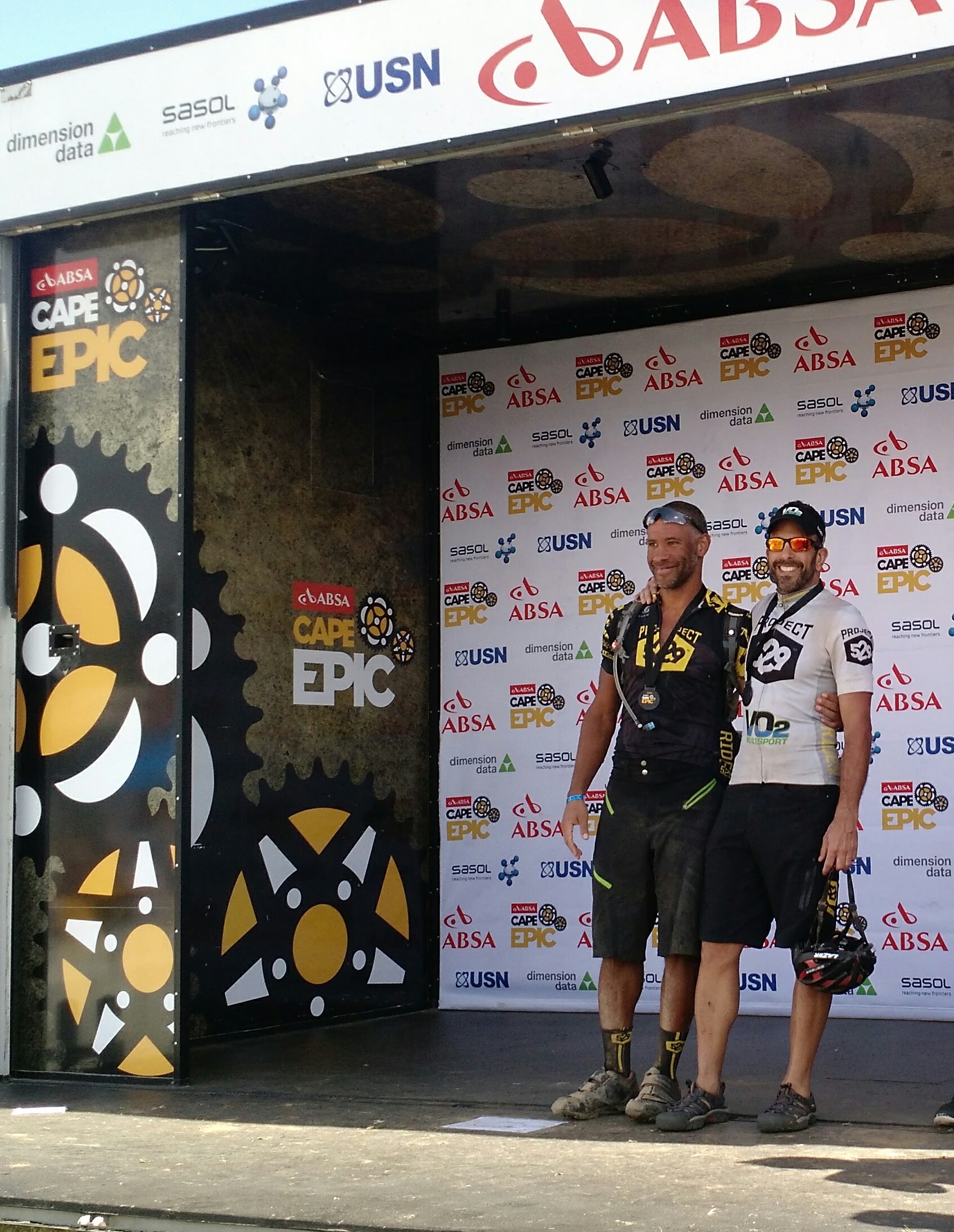
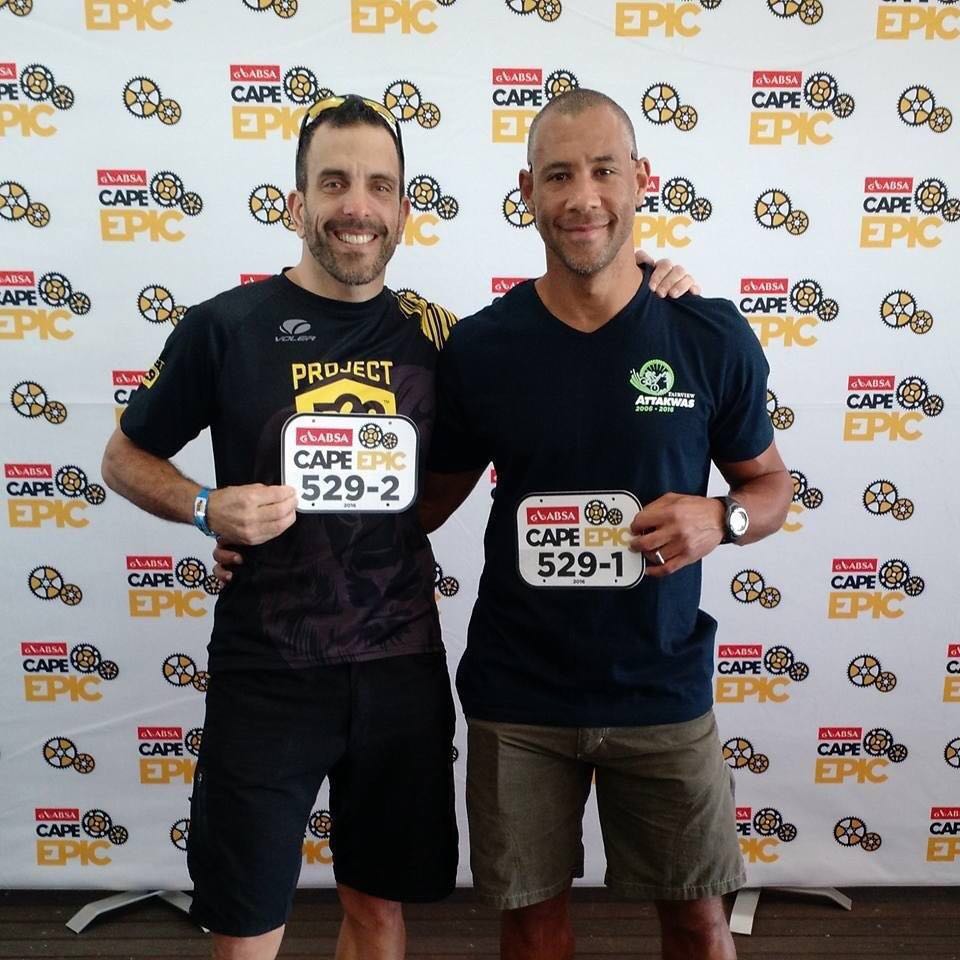
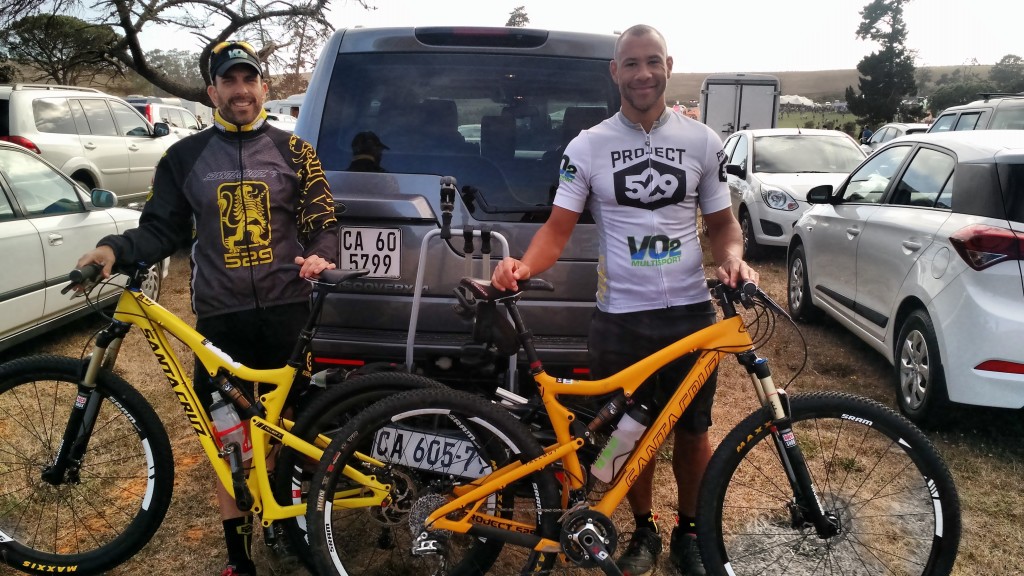
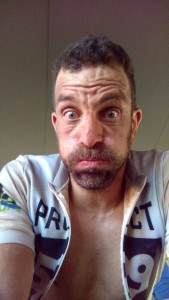
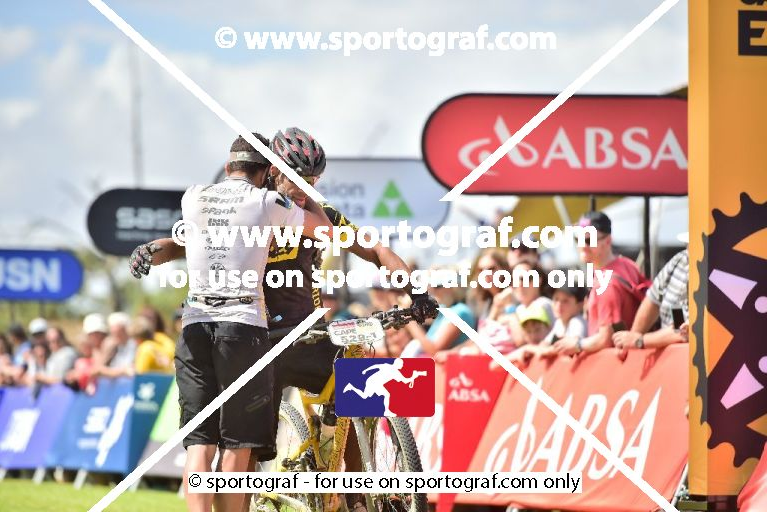
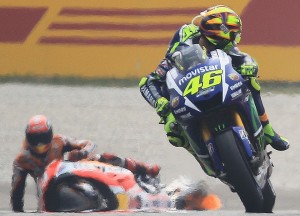


 First of all, there is 2300 feet of climbing (according to Garmin and Strava). That delta may not seem like a lot, but it matters. Second, there is one or two “sustained” climbs, but nothing very long. Long to me is Tiger Mountain in Seattle. Or the 7 mile climb on the Cap Forrest 50. Those are long and sustained. Aside from the two longer (and I am being super generous here) climbs, there was nothing that was very long. Sadly, they were very steep. Very. Steep. The only race where I have seen steeper is Roslyn, WA, which starts with a complete “you’ve got to be sh!tting me” type of climb.

 It wasn’t the race I wanted. It was the race I got. I can’t possibly be upset with a PR. I can be a little upset that I hit some problems on the run, as per usual. The silver lining is that the problems on the run were new. We’ll get to that.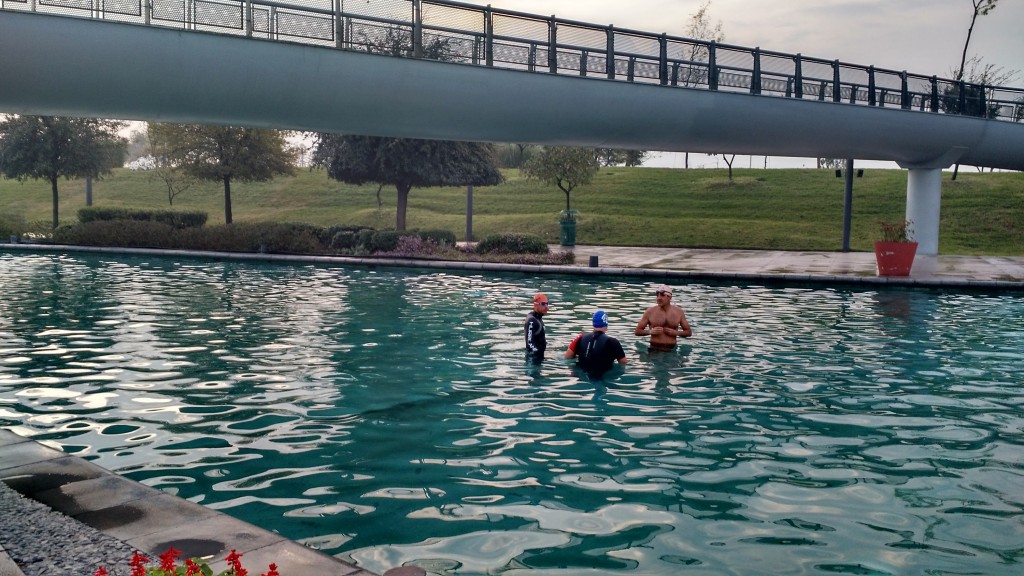
 There was one cool post race item. If you ask this specific pro for a photo at the airport, not only will he say yes, he will talk to you for 20 minutes. Faris Al-Sultan was a class act. I should probably figure out how to smile before taking a selfie. Doht!