Garmin Love Letter

Dear Garmin -

Hey girl, how are you doing? It’s been a while since I have told you I love you. I love you.

Why? Come on now, don’t play games.

When I needed you the most, you were there for me. You took a hit for the team. You literally put yourself in harm’s way to save my behind.

We haven’t always got along. Your firmware plays games, and your GPS linkup can be…wait, I’m identifying satellites. 🙂

I never gave up on you though. Sure, the new hotness models have come along, but Forerunner 310 has stuck with me through all the bad races. You’re honest with me, and tell me only what I need to know. You were so open minded to handling a menage a tri, unlike some of the other watches of your age who were too set in their ways to understand multisport events.

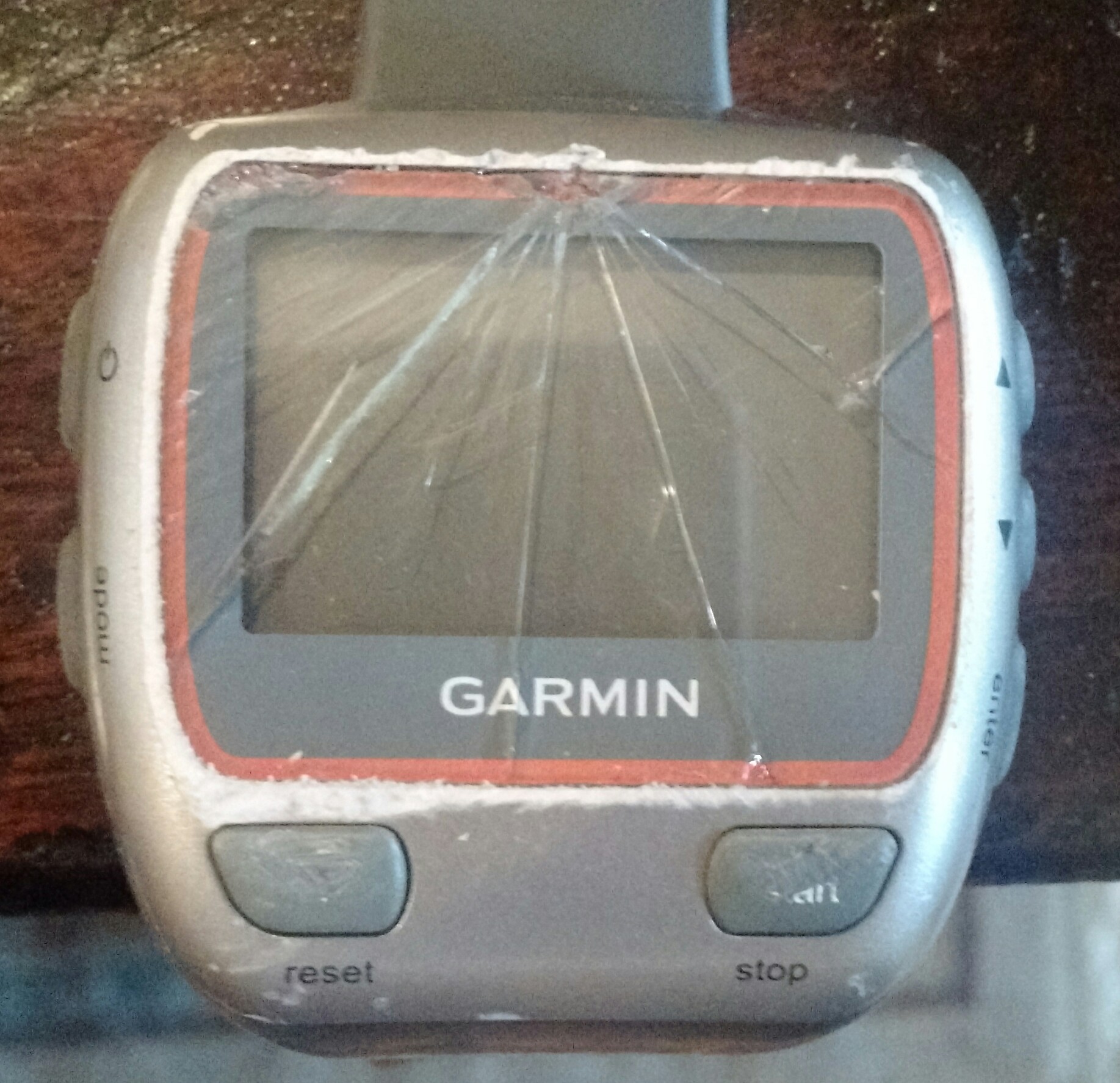
More than anything, I am blown away at how strong you are. I smashed you. Destroyed you. We hit the ground at over 20 mph. Even with your busted grill, you are still working. Amazing.

Your buttons and faceplate may be ground down, and you have an almost unreadable glass, but you are still my lady. Your LCDs are still deliciously lit up. I don’t know if you are hanging on just to impress me, and plan to shortly disappear to the great triathlon in the sky with all the other destroyed fitness computers. Either way, I wanted you to know how much I love you and how much I owe you for most certainly saving me from so much more harm than what actually happened.

Love,

Brandon

Here’s a link to the strava file where I went down. You can see the speed and abruptly stop around mile 29. The bike I was on is a complete writeoff. Twisted rear triangle, destroyed derailer. We didn’t discover that fact until I was a few miles into my ride home and the whole derailer ripped off as I was shifting for a climb. Fun.

We were running a training camp in Coeur d’Alene ahead of the Ironman 70.3 race this past Sunday. I was riding at the back of our group of athletes. There was some debris on highway 95. By debris, I mean large rocks the size of two fists.

I have never crashed on a road bike before. I’ve been riding proper road bikes since 2001. Been hit by a car once, but this was the first bona fide crash.

Going over the handle bars, I was surprised by how clearly my mind snapped back to my 4 years of Ju Jitsu in high school. I began putting my left arm forward to roll through the crash. My hand caught on the bars, and all I could think was “other arm!!” even though I was flying on the wrong vector to roll on my right shoulder. I didn’t quite make it, but did manage to get my right arm in front of me with watch side down.

It was at this point I heard the very loud grinding sound. I felt it all the way through my body. I thought my head was sliding on the ground. And then I was upside down, then rolling, and then stopped in the ditch on the side of the road. We estimate that I slid for well over 50 feet with my weight fully supported by nothing but the Garmin Forerunner 310 XT before I flipped over and stated rolling.

My right shoulder, elbow and hip were a scraped up bloody mess, but I was fine. Hurt. Embarrassed. But fine. My watch, on the other hand, was not. You can see that in the photo here.

IMG_20160628_151846For those who would like to see the damage to my body, and don’t mind a slightly NSFW picture, we took a photo a couple days later. Good times.

If anyone who reads this knows anyone at Garmin, please make sure this love letter finds its way to them.

Ironman 70.3 Augusta Race Report & 2015 Tri Season Recap

In general, there are no “bad” days when you are racing. To have the opportunity to behave like a boy for a prolonged period of time, without a care in the world (other than “get to the finish line”), is a magical thing. Sure, there are days when you could have performed better, got hurt, or even had a DNF. Those suck; they aren’t bad. You’re still racing.

For anyone looking to race in Augusta, here’s the stuff you will care about:

  • The current in the river is real, and it’s fantastic. I got my pre-race information from this site for the Savannah River flow rates. Overall, with a point to point swim you can loaf it in the water and still be fine. I think there was a minute and half between 25th place and 89th in M40-44, and 89th was 26:51 (me), and normally I am 31-34 minute swimmer (depending on conditions). I was holding back…more on that later.
  • The bike course doesn’t feel as flat as the profile. It *felt* like there was more up and down than the 1K feet vertical. The wind on the bike course seemed to be moving around, and felt like the was a consistent head or side wind. For the most part, the pavement is serviceable. I don’t recall any “whoa!!” moments with potholes or anything like that.
  • I am not sure that there is a term “absolute flat” (as in absolute zero, #nerdreference) but this run course is that. It also belies a bit of logic in that it never seems to cross itself, but there are multiple double backs. There are many spots with double-backs, so there were loads of viewing opps if you have kids.
  • Staying out at the hotels near the Jameson Inn is totally fine if you have a rental car. Side bonus, Waffle House around the corner.
  • The morning of the race, park at the garage across from the host hotel for $7, get on the shuttle, go to transition, and catch shuttle back. Get on the first shuttle, regardless of your wave start time. The lines for the later shuttles were long, and there’s no reason for that stress on race morning. One guy on my return shuttle went back to his car to sleep for an hour.
  • Despite cloud cover every day I was there, the temps were low to mid 70s, but the humidity upped the real feel temp.
  • From a family-friendly perspective, the fact that the swim start is a solid half mile from the host hotel, and then another 1.2 miles to the transition area, which is about 2 miles from the finish line, if you have family and/or kids, they will be moving around. Once you go out on the bike, they won’t see you again. They will see you plenty on the run.

With that out of the way, here’s my read on how the day went. It was a great day. Not a good day, but a great day. Why? Because I finally ran off the bike. The. Whole. Damn. Run.

It’s been a long time that I have been tilting at the 70.3 and 140.6 windmills. Prior to this race, I had 10 half Ironman and 2 full Ironman races to my credit. That’s almost 1,000 miles of racing. Sadly, almost every race played out the same way. Decent swim, reasonable to good bike, catastrophic failure on the run.

When I first signed up with Coach Ben of VO2MultiSport in Bellevue, WA, I came in after a long hiatus from racing due to kids. We started our journey together almost exactly three years ago. In that time, leading into this race, I had done 1 IM and 5x 70.3 races. My 70.3 PR was a 5:44, which came on the back of a very fast bike, and horrifically terrible run, in Florida.

I didn’t have a background in endurance sports, but figured if I just kept at it, I would improve. My first race was a smack in the face. Over 6 hours. It was in Kona, HI, and we figured, based on the feedback I gave him, and the data (no power meter) that I had over rode the bike and blew up in the heat. Racing at Lake Stevens, WA later that year, I put up a 5:44. A solid first year with Ben, and I matched my PR from 9 years prior. My run was a 2:01, and I walked a bit of it. The real challenge was a terrible bike, made worse by having a :10 pit stop late in the race to fix a derailer that came off. The weather was also quite cool; if memory serves, it didn’t get over low 60F that day.

So we thought we had it sorted. I needed a race with cooler temps, and I needed to keep building back my fitness. Thus we planned the 2014 season. A repeat appearance at Kona (looking back, this wasn’t a great decision, but I felt “beaten” by the course, and couldn’t let it stand), and IM Canada. I wanted another IM, and living in the PacNW at the time, I believed Canada would likely be very cool relative to other locations in July. The heat in Kona beat me into ground for a second year. The wheels came off on the run, again, with the same issue; legs not responding to “run” command. IM Canada, same problem. Also, strangely, it was very hot that day. Heat seemed impossible for me to escape.

The real challenge was trying to figure out what was happening. Every sign pointed to heat. I would come off the bike, and would not be able to run. The legs simply didn’t work. I could run for short spurts, and then would have to walk. There was nothing there. Sometimes I had rot gut. Sometimes I had gas issues. The hard part was that this problem only surfaced on race day, and in some race simulation bricks. Specifically, I was having the biggest problem with the “tri” part of triathlon.

Ben and I looked at the data. We looked at my salt intake. My nutrition. My diet. We changed our approach to training. I was willing to try anything.

Additional data which started to surface, now that we were micro-investigating, was an annoying habit of my inability to ride consistent power for more than 2 hours. The power would just start to slide off. My FTP (tested) is 250W. I haven’t tested since Nov 2013. I should test again, but riding harder didn’t seem like it was going to help, and I couldn’t hold power any way. I had to prove that I could ride at 82-85% and then run.

To be honest, it was just weird, but I loved the training, and I liked working with Ben. I could tell I was making fitness progress, and I was able to do all of the different races I wanted to do. Long distance running. Half and full Ironmans. Sprint XC mountain bike racing. Endurance mountain bike racing. The problem of running off the bike seemed solvable since there was almost :30 difference between my 70.3 run PR and half marathon run PR (set in 2014). Maybe all my problems were related to a lack of focus. Who knew. At least I was racing.

When 2015 rolled around, we had a singular focus; to PR. We changed my nutrition to full liquid; no more gels. We figured that would solve the rot gut issues. It did. We also focused on me drinking more water. This is something I did to a fault in the first race in 2015 in Monterrey, Mexico. Regardless, I had a great bike, and a good 4 mile run, then a ridiculous 7.5 miles of stupidness, followed by 2 miles of running. My legs wouldn’t work. We thought I just had too much water sloshing around, but the legs still didn’t work. Looking at the power data, I over rode the bike (a common theme), and my power dropped off as usual. That said, I PR’d by 8 minutes. However, and this was the rub, it wasn’t hot. In fact, it rained on us during the bike. Was over-heating my issue? Over biking? My first lap was 9 minutes faster than the second. My overall power was not where it was supposed to be.

Entering the second race of the season (IM 70.3 Boulder), I was completely keyed up on following the bike plan to the letter. I did not want to have that be an excuse. Post-race analysis showed that my numbers looked fine, though they again showed that annoying trend of my overall power numbers coming in 10% under target. However, getting off the bike, I actually felt great. My power didn’t show spikes, and my HR was within the limits we had set. Yet, the wheels came off on the run. It was also in the 90s that day. So was it just heat and sodium as my issue? Comedy of errors, I PR’d again, but this time by 1 second.

A common problem I would have after hard rides was that my legs would be tight for a couple of days after. They would feel like bags of cement were in them. Transition runs didn’t work out if the ride was over 50 miles. Long runs the next day were always challenged. I had no answers to questions I wasn’t specifically asking. I just assumed this was “normal” wear and tear.

I found myself in August starting to think that 10x 70.3 races was enough. I wasn’t having fun any more. Blowing up at races sucks. Explaining that to people after the fact sucks more. Watching first timers go faster than you really sucks, but watching people post faster times than you when you know you aren’t performing at your best is a super bummer. When you repeatedly fail at something, you either have to try something new, or stop doing that thing.

I asked for help. I had the luck of meeting a local pro and asked her how she solved her run off the bike problem with her switch to 70.3 distance. We talked about the problems she was having, and I echoed similar problems. So she suggested I make an appointment with her bike fitter. I was hesitant, as I had done a bike fit a couple years prior. However, this was advice I asked for, so ignoring it seemed silly.

Ryan Ignatz at Colorado Multisport was the suggested fitter. I could tell straight away that this was a different level of attention to detail than my last fit. The questionnaire was fine, but the Retul bike fit system was super cool. There’s a cynic in all of us that would think “of course he said your fit was wrong, he’s a bike fitter!” I will admit, part of that went through my mind. However, what stood out to me was that Ryan watched me pedal for a bit, and then said two things: first, that my pedaling mechanics were strong, but second, that I was pedaling wrong.

These two seemingly incongruous statements were hard to grasp. Then he showed me with pictures, video, and wireframe. Then he explained it to me very simply. He wanted to lower my seat, and raise me up in the front. My first thought was “well that’s not aero.” A little too much time on Slowtwitch forums perhaps. The reason he wanted to do this? My foot was pointed on the down stroke. So? This was the point in the conversation where he blew my mind: he told me “you probably blow up on the run and you don’t know why.”

Mind. Blown.

He then proceeded to ask me to push down with my leg with my toe pointed, and then with my heel down, and asked what different I felt. The former used my quad; the latter used my hamstring and glutes. For years Ben has been telling me to use my glutes, but until this very specific set of questions was asked, I did not know enough to know that I didn’t know what I needed to know. Quads are for running, and you also burn through your glycogen like mad when you use them. So Ryan made the changes. In all, I spent about 2 hours on that fit, and found that I was feeling burn in places I had never felt burn. He told me it would take some time getting used to the new position, but also that muscles that had not previously been used would need to be build up.

Over the course of the next month, on the run into my race, what changed did I notice? Not once did I have a problem running off the bike. Every run felt like my legs were fresh. In my race rehearsal, I ran a 10K off a 60 mile bike. And ran the whole thing. My average power numbers were up for rides over 2 hours. I was back near 82-85% FTP for the full distance, which is where I needed to be on race day. In short, I was floored.

This has been a whole lot of sharing to get to the point. 30 minute PR on race day in Augusta. PR swim (the current helped). 2nd fastest bike. PR run. 5:06. I was holding back in the swim. I was pulling back on the bike when I had the wind, and was super conscious of my HR the whole time. I even had to watch myself on the run. I did run into some problems on the run, mostly related to some stomach issues (TSS of 188 would suggest I rode too hard in the wind), but I was in completely uncharted territory from mile 4 onward. I had never known what it was like to be running, well, that late in the race. The whole time I kept pulling back to keep my HR in the limit and not blow up. 13.1 miles of fear of blowing up.

It was a great day.

The knee-jerk reaction would be to think that the silver bullet was the bike fit. That would be fun and easy, but also wrong. Changing your bike fit isn’t going to make you magically fast. 3 years of hard work, with excellent coaching, set up that day. Three years of hard workouts, waking up early, and putting deposits in the pain bank. A bike fit won’t get rid of rot gut. A bike fit won’t deal with sodium deficiency. Triathlon is a very hard sport. Long course tri is super hard. At best you are on a 70.3 course for 4.5 - 5 hours of hard effort. When things go pear shaped, you could be out there for 6-7 hours. It’s even nuttier for a full Ironman. There’s too many factors that go into a race result. Getting that last move on the Rubik’s cube may appear to be the one that solved it, but there was really 100+ moves before that which are quickly forgotten, often ignored, and seldom given credit.

Ryan gave me the last move, and for that I thank him. Ben gave me moves 1 to 100. When I got to Ben, I had been out of racing for 6 years, weighed 192 lbs, and had recently recovered from a broken neck. When the bike fit was made, I was 162 lbs, able to ride centuries with no problem, and having the time of my life with challenging endurance events I would have labeled ‘nutty’ or ‘impossible’ for me in 2013. Ben and I have a lot of work left to do, and I’m looking forward to seeing moves 102 to who-knows-what-number. Next season I’m racing in the Cape Epic in March, and a 70.3 in June. Broken neck and overweight to Cape Epic in 5 years. Amazing. The following year I will look to do either a healthy slate of 70.3 races, or maybe the Leadman series, or perhaps even a return to full Ironman racing.

11th time was the charm for me at the 70.3 distance. And for once, at this distance, I was smiling on the run and ecstatic at the finish.

The morals?

  1. If you have a coach, and you trust your coach, put your faith in that trust, and know you will be prepared for all your races.
  2. Don’t be afraid to ask for help.
  3. It’s seldom just one problem.
  4. Small changes matter; in this case, the seat height difference was about the width of a piece of tape.
  5. Small changes add up (nutrition, training, sleep, habits, salt, water intake, etc).
  6. Have fun; if you aren’t having fun, it’s time to find something else to do.

1154_049343

Xterra Las Vegas Race Report

I decided to mix things up this year and try a few different competition formats. This was mostly to keep the year interesting, and to hopefully stave off the inevitable burn-out which comes from many months of sustained training. Based on the performance at this race, I have a mixed reaction thus far to this strategy. There is no question that I was inadequately prepared to perform at a high level for this format. However, I had a great time, and had some really nice outcomes from a personal development standpoint. I’ll chalk it up as a victory.

When selecting my races this year, the conversation with my family has largely revolved around not turning vacations into race-cations. To that end, I’ve had to select races that were either close to home, super spectator friendly, or I would be there alone. This was the case with the Monterrey Half Ironman I did last month. Definitely not a great place to take the family for a fun filled vacation. Language barrier would be the hardest obstacle.

Las Vegas is a location the wife and I have always talked about going to with our kids. We thought we might try to do it this year. However, neither of us had ever been out toward Lake Las Vegas (the race venue) and we weren’t sure what to make of this as a venue. We wouldn’t be near the strip, and I didn’t want them to feel trapped. Further, based on all of the on-course photos I had seen, it wasn’t clear that this was a spot where we would have a fun time with the kid-bots.

Turns out we were right and wrong. The location is in the middle of nowhere. That’s not a lie. Getting to the turn-off from the highway, in the dead of night, feels like you are pulling into no-man’s land. To get to the Westin is about another 2-2.5 miles of driving, and there’s not much in the way of lighting. It felt remote. It is remote. However, the Westin has a high production value; very resort-y feel. They have multiple pools, with a splash pool dedicated to kids, and a larger pool targeted at kids, which also has a water slide. They also have a beach with access to the lake, and additional amenities. My kids would have had a blast. The race itself doesn’t afford a ton of viewing possibilities, with the exception of the swim exit and the entry/exit point from the main road (blocked on raceday) to the trails (but really, a rock quarry). If you are going to the races with your family so they can soak in a very high energy vibe, this may disappoint. Put a different way, there were more people in my wave in Monterrery than racing in totality in Vegas. That’s not a bad thing, per se, but it’s definitely a different feel.

I arrived late on Thurs night so I could spend Friday with a pre-ride of the course and a pre-swim. Both activities made me feel way way worse about the coming race. By all counts, I should have been feeling supremely confident about this race. The distance is shorter than 70.3 racing, I’m a reasonably competent mountain biker, and the total race time would be hours shorter than 70.3 racing. Some of this worked out in my favor, but others did not.

Let’s start with the bike. Below is the map as presented by the race organizers. 17.5 miles and 1400 feet of climbing. Additional information provided by race direction (in the athlete packet) included additional information. Specifically, it said not to expect protracted areas of sand, and to expect long sustained climbs. From my hotel room, where I could see some of the course, things looked pretty tame and I was excited. The pre-ride revealed some hard and bitter truths.

VegasBikeMap2014First of all, there is 2300 feet of climbing (according to Garmin and Strava). That delta may not seem like a lot, but it matters. Second, there is one or two “sustained” climbs, but nothing very long. Long to me is Tiger Mountain in Seattle. Or the 7 mile climb on the Cap Forrest 50. Those are long and sustained. Aside from the two longer (and I am being super generous here) climbs, there was nothing that was very long. Sadly, they were very steep. Very. Steep. The only race where I have seen steeper is Roslyn, WA, which starts with a complete “you’ve got to be sh!tting me” type of climb.

What made these climbs harder was the fact that the surface was loose rock on top of hard pack, which meant poor traction on the line. The other issue was that there was one line, and it was three inches wide. Get off that line, and you are into the really rough marbles. This course rewards staying on the race line. Do not waver from the race line.

Most of the climbing is in the front half of the course, and when I finally felt like I was descending and done with it, and on to some ripper parts of the course, I discovered the other truth about this course. Sand. Lots and lots of sand. There is one specific part of the course, maybe a half mile in total, where you are riding in sand. Deep sand. Tuck your front and drop the bike if you are not on your game sand. For a pre-ride, I was super discouraged. I had never ridden sand before. I wasn’t having fun.

The last part of the course is this single track section that runs along the shore of the lake. It’s not that challenging, but has sand, and many thorns if you get off line. There are also several long corners that are off camber, and right above a steep drop. Short drop, but they are penalty corners if you get them wrong.

Based on my initial read of the map, I figured I would be done in the race at 1:30. Based on my pre-ride, I adjusted my expectations down to a 1:50 for the bike portion.

Discouraged from the bike, I went back to the hotel to rest. The swim course wasn’t open until 1pm, so I had some time to get off my feet, which was welcomed. The other truth about this course is the wind. When it wants to blow, it can howl. When it howls, it churns up the lake. The swim course was set up as a two loop affair. My inner sense says we swam longer than 750m per lap, but I didn’t swim with a GPS unit. The pre-swim, though, was a complete mess. The current was so strong. I was riding waves on the way back, and having trouble getting breath without swallowing water. When I hit the beach after the pre-swim, I was super discouraged. Many athletes were complaining about the current, the chop, and how tired they were. Oh well. You can’t control the weather, and it was going to be hard for everyone.

With Friday out of the way, I had to get my head around a new race format. Since this was my first off-road triathlon, I wasn’t sure what to expect for times, the level of competition, or how to pace it. I did run into a guy who was wearing a finisher shirt from a race I did in 2014, and asked him how many of these off-road races he had done. He said quite a few, so I asked about the level of competition versus half Ironman racing. His response, which was perfect, was, “It’s always fast at the pointy end.”

Coach Ben had given me some advice ahead of the race, but the one that stuck out was that I was going to get a lesson in how fast people can ride mountain bikes. I knew that my training has been focused on the three half Ironman races I am doing this year, and that what is required to go fast on a mountain bike is a combination of intervals and handling training. I had not done much for bike handling skills this year. My intervals training was not focused on mountain bike racing. This race was a nice reminder of the difference between road-fast and mountain-fast. These boys (and girls!) can ride. Young dudes. Old dudes. You name it, there was fast a plenty on the course.

When the gun finally went off for my race, I was actually quite calm. I was suited up in my new Roka Maverick Elite wetsuit. The winds had died down a bit over night. My warm-up swim felt really good. BOOM! The cannon went off and we were off into the water. This was my first tactical mistake. I am a capable swimmer. Usually. For this particular swim, I had done myself a disservice in the pre-swim by allowing the current and chop to get into my head. I really fumbled this swim. Bad sighting, poor heart rate management, and overall labored affair. I did not do my training justice.

The bike itself was rather what I thought it was going to be. Hard. Much harder than the profile on the website suggested, but inline with what I previewed the day before. At least I knew where the steep bits were, and had a sense of what I was going to be running into along the way. Knowing those things didn’t keep my HR under 170. It’s not the best bike course in the world by a long shot. I did, thankfully, discover that there is a non-sandy (quad sapping to the uninitiated) area in the flood wash area. I sadly didn’t discover that until the first lap of the race, but did use that info on lap 2, and during the run.

130959-006-027f_med 130959-054-033f_med

My main objective for the run was simply to run the whole thing…I have a nasty habit of blowing up on the run in triathlons. Save for some of the really steep pitches on the run, I accomplished that goal. I was even smiling for most of the run. That was a welcome happening.

I don’t know who that other guy is, but he got bunny-eared.

All told, this was a fun format, to be sure. I was not adequately prepared to race this format, as all of my A races this year are 70.3. I may decide to do more of these in the future. I don’t know. I feel much more engaged on the bike when I am on a mountain bike than when I am on a TT bike. That will be something to think about throughout the rest of this race season.

Many thanks again to my wonderful wife Christy, for supporting my racing hobby. Coach Ben for his continued training, support, and mentorship. The Project 529 Legion boys for all of their long distance support. #RideMore #SummerOfSRAM

Monterrey 70.3 Race Report

IMG_20150314_115555116_HDRIt wasn’t the race I wanted. It was the race I got. I can’t possibly be upset with a PR. I can be a little upset that I hit some problems on the run, as per usual. The silver lining is that the problems on the run were new. We’ll get to that.

In my pre-race report, I noted the lack of English speakers with the registration process. On race day morning, I was a bit concerned heading over to the transition area that it would be more of the same. It was a welcome thing to hear Michael Lovato on the PA system repeating things in English. That removed a huge potential area of stress for the morning.

For anyone looking to do this race in the future, I would strongly suggest you stay at a hotel near the transition. The Artemis Cintermex was a fine hotel. Nothing specifically wrong with it. The issue was having the schlep over to the transition area the day before the race, and all the way back. And then again on the morning of the race, and all the way back (for the swim start, which was over by the Cintermex Center). The time on feet in the days/hours ahead of a race are best kept to a minimum.

One of the reasons I love racing is the opportunity to reconnect with old friends, or get to know old acquaintances better. In the transition area, I ran into a fellow VO2MultiSport team mate, as well as a friend from my last job. No matter how much time passes, it’s always nice to slip back into familiar relationships.

The weather reports for the week had been a mixed bag. The sun never really found a way to come through during my stay, and the report for the day was calling for rain during the bike portion of the race. Since this race location doesn’t allow for a pre-ride of the bike course, this was making me a bit nervous. The most worrisome portion of the bike would be the cobbles in and around the transition area. In all, it was about 2 miles per lap of cobbles. Anyone who knows knows that wet cobbles are no fun.

Back over at the swim start (about a 25 minute walk with all of the athletes making the trip from transition) things were a bit crowded. In the pre-race report I already spoke to the size of the swim area, but hadn’t really factored into my mental model what the start area would look like. Lots of people. Athletes. Spectators. Well wishers. Loads and loads of people. Not a lot of space.

Pro tip: for this race, bring toilet paper from your hotel room. There are some public bathrooms, which were quite clean, but the toilet paper situation was dire. I noted this the previous day and thought ahead to bring some.

Due to the max flow rate of the swim area, there were to be lots of wave starts. I’m guessing that the thinking of the organizers was to to put the slowest people at the front to ensure they had the full 1:10 to complete the swim. Unfortunately, that meant traffic. Lots of bodies. My age group (40-44) had 3 waves, and I was in the second one, going off at 7:55A. A full :55 after the pro males.

The queue up process was well organized, and the flip flops they gave us for the walk over worked out nicely. Much appreciated. Unfortunately, like much of the schwag at this race, the race caps were poor. I saw a few people ripping their as they were getting ready to enter the water. I too had this problem. I was fortunate to have seen the table behind the queue up where they had some extras, but an athlete shouldn’t have that kind of stress on race morning. Looking at my cap and comparing it to other caps from other WTC races, it’s hard to see if these are thinner, or cheaper material. They feel like it.

While on the topic of cheaping out, what is going on with the backpacks that WTC is giving out at the races? My first Ironman Canada bag had a zipper come off while I was still in the registration tent. They gave me another one, but within a handful of minutes a zipper came off the new bag as well. The backpacks at the Monterrey race were ridiculous. The straps would not stay in the plastic binders. If you put your arm through, the strap came completely undone. The solve was to tie the nylon in a knot, but why should I have to? For all the money we pay to race at these events, you would think that they wouldn’t cheap out on the schwag. I’d almost rather they not give me a backpack than give me one that demonstrates a level of “f!ck giving” that is sub-standard. This was also the first race where getting a race bike jersey or tri top felt like a losing proposition. The quality of the event gear in the expo was quite poor. Even the water bottles were cheap; never to be used on a bike ride.

Back to the race. My wave made it’s way up the sidewalk area next to the swim start, and eventually we were called into the water. I’m pretty sure that the water temp dropped 5 degrees from the previous day. I did my pre swim without a wet suit. For the race, in my wet suit, I was surprised at the cold. With about 100 competitors in my wave, the feeling of tightness in the starting area was acute, given the width of the “river.” I pushed my way toward the front, assuming that I could get a good start, settle in, and target a decent (though by no means fast) 32 minutes. It was the first race of the season, and I knew there would be tons of bodies, making a fluid swim difficult. Oh how right I was.

BOOM! The air horn sounds and we’re off. Bodies. So many bodies. That moment, when you swim into the back of someone who is standing up. That’s not a great race moment. It happened at least 4 times in the first 300m. Likely closer to 6-7 for the duration of the swim. What a cluster.

During my pre-swim, I swam half the course out, and then back, not wanting to walk the 1.2 miles back. I wish I had swam the whole thing. There were parts of the swim that were so shallow that my fingers were scraping the bottom. That’s not hyperbole. I snapped a photo from the pre-swim. It’s that depth or shallower the whole way.
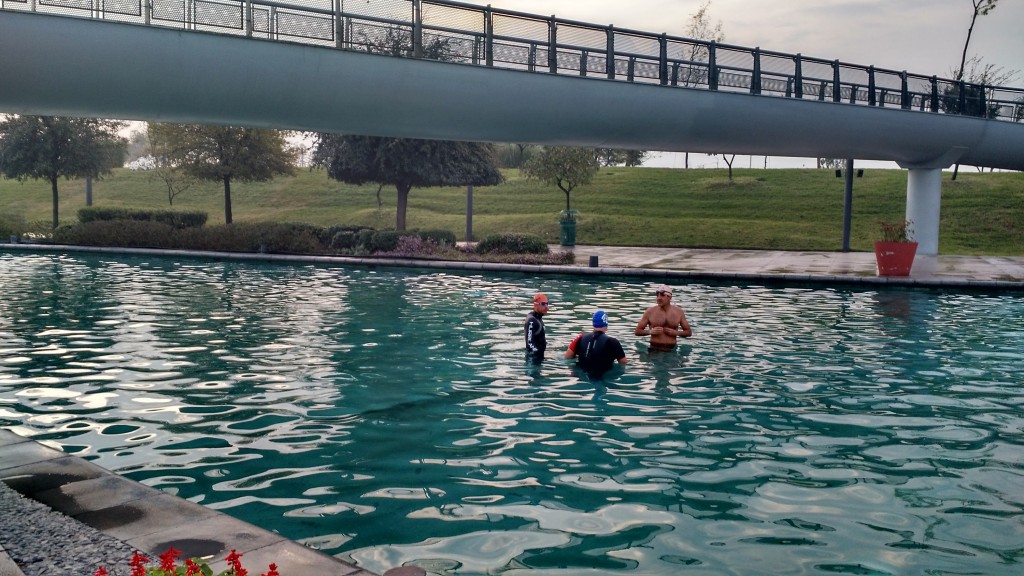
IMG_20150314_073100303_HDR-EFFECTS

I’m fairly certain that no pre-swim would have given the same level of water displacement as the number of bodies in the water ahead of me. It was like swimming in a washing machine. Somewhat challenging to time the breathing, and I swallowed more water than I would have liked.

After about 500m, I settled into a rhythm, and caught the draft from a guy in my group. He was breathing to my side, so we were looking at each other as we went. For about 600-700m we swam together, each of us taking a pull in front, and allowing the other to draft. It was a great working relationship. Then he disappeared. Then I ran into someone. Doht. The number of competitors standing around in the swim was a bit nuts. I eventually snuggled up to the left wall and got comfortable. I hoped that most of the standers would be in the middle. I was mostly right.

My only area of concern from the course walk through was where the channel narrowed to barely 5 feet across, with railings, like a log ride at an amusement park. By this point things had strung out, and I got through without incident. Before I knew what was going on, the swim was done.

Sadly, I swam 35 minutes. That’s slow for me, especially in a wet suit. I take solace in knowing that one of my friends (she qualified for Worlds…go girl!), who is a sub 30 minute swimmer, swam a 32, and she was in a very early wave (so she had little traffic).

Fun fact, I counted 6 different color caps during the swim from people I overtook. 6. Waves were 3 minutes apart. That’s fun.

Coming out of the water, athletes are treated to a long upstairs run (wet stone, for those of you playing at home), followed by “find your bike” in very long rows, with zero margin for error. If you managed to go down the wrong aisle, you have to run all the way to the end and double back. This is unlike just about every other race I have done, where there are breaks in the aisles in case you are in the wrong place. I was glad I ran the route several times the previous day, and looked for land marks to line up with my bike.

Once out on the bike, we hit the first bit of the cobbles. As it was still dry, and we were all just getting our legs under us, it was a largely uneventful mile or so. Before I knew it, we were on the highway. The ride for this race is a mostly unremarkable thing. It’s not picturesque. It’s mostly flat. There was no traffic. Some good. Some bad. The really crummy parts were the botts dots on the road, running the whole width of the highway, and for several hundred meters. Those can be squirrelly if you’re not careful; all the more so if they are wet. Oh, and the potholes. Filled with water. Also fun, and very easy to see, I assure you.

The water send-ups were spaced every 10KM or so on the bike course, which made for an abundance of water. My race plan was pretty simple. Stay below 155 bpm HR. Hydrate well. Kick ass on the run. This year, my coach and I were trying a new nutrition plan. I have been plagued with rot gut in longer races, and we have simplified as much as we can by casting out the Gu gels, and taking on liquid nutrition in the form of CarboPro. My body generates a ton of heat. Lots of lean muscle, I’m told. My mental time checks have me drinking water on the clock at :03 and :07, sometimes at :05, and taking a mouthful of CarboPro bottle on the :10s. 800 cals for this bike leg. I’ve been practicing this way all through the winter from the switch in nutrition. I must have not been paying as close attention to my water intake on this bike. Looking back now, I consumed close to 80ozs of water in my aero bottle, and another 24oz with my CarboPro. In retrospect, that was way, way too much. I wouldn’t find out how badly I was off course until much later.

I hit the first turn around in what seemed like a fast time, and by the time I came off the highway, and headed back in to town, I was pretty confused at what I was seeing. My time seemed too fast for the effort. Then all hell broke loose. The rain had started while I was about :10 out from town. It came down heavy at first, and then tapered off, but was still steady and annoying. Well, annoying is a relative term. It was annoying on the highway. It was fear inducing on the cobbles. Hell is wet cobbles.

At first, I wasn’t sure what to make of it all. The road off the highway back into town was a straight shot. Aside from the crazy shaking of the headset on the bike because of the cobbles, it didn’t seem too bad. The road then goes under the highway for a bit (making the cobbles dry), at which point we came upon a huge crowd yelling something. The guy I was passing said in English “what are they saying?” All I heard was “DESPACIO!!!” I couldn’t figure out why they were yelling “slow.” I wasn’t going that slow. What a bunch of jerks. But they were screaming. And screaming. And then I saw the right hand turn. That went down hill. And then it all made sense (also…not jerks). Oh f!ck.

It was at this moment that both of my tires let go on the pavement, and I started a two wheel slide toward the outside of the curve. I’ve been in this position before. I used to race motorcycles, have spent plenty of time on mountain bikes, and am pretty comfortable when wheels slide. Except not this time. My only thought was “this is going to make an awesome picture, or it’s really going to hurt.” As luck would have it, my muscle memory kicked in, and I didn’t do the one thing that would have caused dramas - grab the brakes. I put more power to the crank, figuring that at some point my rear wheel would hit a cobble seam, and hopefully I could use it as a berm. I was right; the bike snapped to and I almost got tossed out of the seat. The relief was short lived, however, as we were now going downhill, on wet cobbles, under an overpass, and the road then went to the left, into a blind corner. What treats awaited us on the other side?

Bodies. Lots of bodies. Walkers. Layers. Kneelers. The funny thing about wet cobbles is that they tend to be slick, and lack traction. A point well made by all of the cyclists who came through the terrifying right-hander to the downhill, and decided that it was time to grab the brakes. What they then found was that going up this short, steep hill, was next to impossible. So they were bailing. Or crashing. Or stopping outright. While I felt bad for them, my primary concern was in not being one of them. Unfortunately, while race direction had roused the crowd several hundred feet back to yell at us to slow down, there was no one directing the unfortunates to the right side of the road, and out of the way.

Once I cleared that mess, I was pretty shaken. The cobbles were still there, and I wasn’t clear on when they would be done, having not had a chance to pre-ride the course. Luckily, it was only about another quarter to half mile until the lap was done. When I hit my lap timer, I looked at a 1:17. That was a surprisingly fast lap, and I knew I should pull it back to save my legs for the run. So that’s what I did.

Remember that whole section above about drinking a lot of water? That came home to roost on lap two. I have only once had to pee during a bike leg on a 70.3. Once in 8 previous tries. On this ride, I had to let go twice. So. Much. Liquid. At this point of the race, I hadn’t computed that I was creating, and exacerbating, this problem. I just kept drinking on the clock. This problem would get worse.

I definitely pulled it back on the second lap, giving back 6 minutes and finishing in 2:40. Not a PR bike ride, but it was my target time, so I was happy. I figured I was right on schedule for a PR and a great execution.

In retrospect, my HR was too high. Having had a chance to look at the bike data, it’s clear I was too high on the HR according to the plan from my coach. Side note: pro tip - zero your Power Meter when you travel from a very cold and dry climate to a warmer and much more humid climate. There’s no way you do a 1:16:54 at 177W and weighing 160lbs. Good thing power wasn’t the governor of my performance; I was strictly racing on HR numbers.

With the second lap done, I was ready to rock and roll on the run. In just about every previous triathlon race over Olympic distance, I have suffered on the run with gastro issues. My plan for the run was to spend the first two miles getting settled (average 8:30-9:00 pace) and then pick up the pace, with a HR target of 160. I should have known I was in trouble straight away, and Strava helps make that point.

I spent the first two miles looking at pace, and feeling really good. In fact, I felt so good that I was surprised at how I felt. This was the first 70.3 where I was running through the field. It felt great. For all of about 4 miles. Then the pain started. My first thought was that I was having the gastro issues. Did I need salt? More water? Was I out of calories? My brain was working crazy overtime trying to figure out what was going on.

Then, as if nothing was wrong, at mile 6, I could run again. Rejoice! Or rather, “rejoice?” Sadly, not. The pain just got worse, and my performance fell like a stone. I stuck to my plan, and kept drinking a little water at every aid station (approximately every 1KM - kudos to the race direction). Unable to diagnose what my specific issue was, I was into the mental pain cave of “just finish strong.” And so it went for the next four miles. I was able to run for about 200-300m and then the pain was just too intense. Then it hit me. Bladder pain. Not stomach pain. Not intestinal pain. Bladder pain.

When doing these longer races, I tend to get numb in weird places, and lose my ability to tell what’s really hurting. Maybe my brain is what goes numb. I don’t know. All I know is that once I said the word “bladder” in my brain, I targeted the next porta-potty, which I found at mile 11. And then I just stood there and forced everything out. All of it. Then, I just toddled off hoping for the best.

Looking at the data now, it’s as if a light switch flipped on at mile 11.5. I wasn’t tearing up the course by any stretch of the imagination, but I was running, fairly consistently, and without pain. I have loads of new data about my liquid nutrition plan, and hopefully won’t make that mistake again.

As I approached the finisher shoot, I saw my friend from Seattle, and thought “how did I run him down?” Turns out he was in a bad bad way. He crashed on the cobbles about 200 feet from the finish. He was struggling to make forward motion. Knowing that a PR was probably off the table for me, I chose to stop and cheer him on. I tried to cajole him to a run. I was jogging backward, yelling at him to pick it up. The crowd got into it. He kept rejecting my pleas. Then he pulled down his shorts (in front of the rather large crowd I might add) and showed me that he had somehow taken half a tennis ball and slipped it under his skin right on top of his hip bone. I have no idea how he made it to mile 13. I told him I would finish, but would wait for him in the finish area. He finally made it across the finish line, and I carried him to the medical tent. We then had a fun time trying to speak with the medical crew (in my broken Spanish; there was far less English here) trying to figure out what to do.

I can only image the fear he was feeling as there are now all these people around you, while you are laying on a table in excruciating pain, and they are talking in quick clips while poking you. He had no idea what was going on. He had no idea how badly he was hurt. The finish line endorphins were gone. Fear settled over the tent. It was chilling to experience.

I did my best to keep him calm. At one point his friend/hotel roommate showed up. After a lot of back and forth, we guessed that he had a broken rib and a displaced hip. The doctors thought a possible fractured leg. We were partially right. He got a ride to the hospital in an ambulance. Apparently the hospital experience is a slow one in Mexico. He ended up staying overnight. He later texted me to let me know that he had a concussed kidney (when did that become possible/a thing), a bruised liver, two pelvic fractures, and a broken rib. Tough way to end the day, though all the more amazing that he finished in 5:56, and was a 1:37 through 17.2K. The final 3.9K? 56 minutes. That’s one seriously tough and determined dude.

I once got hurt racing motorcycles. My best friend drove from Seattle to Portland to get all of my equipment back to Seattle while I was in the Portland hospital getting surgery for a broken arm. I was able to pay it forward with my friend and his buddy. It was quite a bit of negotiating to sort out the “how” part of it, but their bikes, wetsuits, etc all eventually made it back to their hotel. I didn’t actually get out of the transition area until :30 after they had officially closed it. The race official lady who was patient with my Spanish was nice enough to stay long enough for me to make the two trips to their hotel.

My overall time was a 5:36. It was a PR, by 8 minutes, but nowhere near of what I am capable. I still haven’t figured out how to run off the bike. One day I will crack that nut, but the directive with this year was to race often so that I could get the usual “this is your one shot this year” nervousness out of the way. I learned a ton on this race. It was good to see that I can put in a decent bike, even in adverse conditions (cobbles can really slow you down; I don’t know how those pros in Europe do it). I have areas on my race execution which continue to need refinement and attention to execution.

Huge thank you to my wife and family for the support, all my friends back in Seattle from Team VO2MultiSport, and Project 529, and Coach Ben, for his continued insistence that I am better than my results, not giving up on me, and getting a 40 year old man into the best shape of his life and having a ton of fun racing.

Would I do this race again? No. Would I recommend it? No. I didn’t go with the family, and am not sure they would have had a great time. This is not a destination resort town in Mexico. Basic necessities were complicated. Things like getting money changed. Couldn’t do it at my hotel. I needed, apparently, to go somewhere 15 minutes away by car. Some of the ATMs couldn’t talk to my bank, making getting pesos difficult. The lack of English would have made the trip incredibly frustrating for my wife, as she doesn’t speak Spanish. The bike was completely forgettable, and the run was slippery with the wet pavement on the river walk sections (roughly 3 miles of each of the 2 loops), and the swim was a comedy. The kind where only one Shakespearean actor has a knife. The on-course organization was very good. Plenty of water, nutrition, etc. The course was well marked. There was quite a sizable crowd in the Marco Plaza area. Those are all good things, but not enough to bring me back. That plus the possibility of wet cobbles in the future…no way. Wet cobblestones = hell. And the finisher t-shirt was unremarkable, though the medal was a nice blend of national colors and an interesting design.IMG_20150315_164409973_HDRThere was one cool post race item. If you ask this specific pro for a photo at the airport, not only will he say yes, he will talk to you for 20 minutes. Faris Al-Sultan was a class act. I should probably figure out how to smile before taking a selfie. Doht!
Monterrey 70.3 Pre Race Report

I selected this Ironman 70.3 race in Monterrey, MX because it was early in the season, the course is relatively tame, and I felt like an international race in a non-English speaking country would afford a sense of adventure. The result so far? Ah jeez…

Let’s start with the arrival in Monterrey. As an American, if you have traveled to a popular destination in Mexico like Cancun, Cozumel, or even Puerto Vallarta, you would be forgiven for thinking that you would be fine in Monterrey. Not the case. While I have had the good fortune to find small (and I stress, small) pockets of English speaking folks, by and large, this is an English free zone.

At the airport, it wasn’t clear how to get a cab. There was a machine on a wall that had the word “taxi” in the language on the sign. The sign had no translation. It was at this moment that I was incredibly thankful that, over the course of the last few months, I had invested the time and energy in rehashing my high school Spanish with Pimsleur lessons from Audible . I don’t think I knew this much Spanish in high school. The Pimsleur lessons have really helped get me to a place where I felt at least semi competent to get around with basic necessities. The taxi sign was the first test. I passed. Not only did I get a van versus a car, I was able to help two pro triathletes with a ride. This is what really makes triathlon unique and amazing; that we age groupers get to line up in the same race on the same course as the pros. So very cool.

What really drove home how helpless things could have felt was when we were waiting out front of the airport for the cab to arrive. Context is an incredibly powerful tool. In my mind, I had just used a computer to pay for a ride with a company that would send a car. My context, being a tech-savvy American, was Uber. Given the actions I took, I assumed that a car should have arrived. There was nothing on the ticket or on the machine to give me any reason to think otherwise. Of course, there was nothing on the ticket that indicated a taxi would magically appear either. After about 10 minutes of standing around, I asked an airport worker about it (of course, in Spanish), and he said we had to wander down a ways to the little hut. Problem solved. More semi-passable Spanish with the guy there, and we were in our van, with a negotiated second stop for a small extra fee. Awesome sauce.

Further driving home the point that things could have quickly gotten out of hand was the cab driver driving for what felt like too long after dropping off the other two passengers. A quick conversation revealed we were going to the wrong hotel. Same brand. Wrong location. Again, all in Spanish. So, so, so thankful for Pimsleur.

Hotel front desk? No English. People in the restaurant next door? No English? Sensing a theme? Adventure time had begun.

One of the unique features of this race is a point to point swim in a man made channel/river (but really, let’s just call it a big pool). The river cuts a meandering path through the Fundidora Park, with loads of pathways, knolls, and play spaces. Pretty cool place. The river appears to be about 4 or 5 feet deep, and about 20 feet wide, except for certain parts where it widens up. With 300+ men in my age group, there are 3 separate waves to accommodate us. The starting gun should be interesting. I get a crack at swimming in it on Saturday morning.

I also took my bike out for a shakedown ride of about one hour, and then a short 2.5 mile run. The area around the hotel (Artemis Cintermex) is full of streets which I would charitably call bike hostile, and certainly no place you would want to take a carbon tri bike. No way. Fortunately the Fundidora Park has a road that winds through it, though the rain and standing water made for some interesting riding. Caution was the word of the morning.

After the bike ride, I went for a quick transition run. Once again, my inner fan boy eeked in delight as I passed former World Champion Faris Al-Sultan, who was our running the other direction with a couple of other folks. I even got a “what’s up” head nod. I’m such a fan boy…

Registration further added to the sense of adventure, though when dealing with race registration, adventure isn’t quite the word you want to use. English was not to be found. The volunteers, while nice and cheery, were incapable of answering questions in English. A few people heard me speaking in Spanish and then saying something in English (talking to myself, trying to find the right words or simplified concept), and asked if I would translate for them. It seems that there was quite a bit of confusion going around, and I was happy to lend a hand, albeit a very broken Spanish hand.

I don’t know if this is emblematic of other international WTC races or not, but I was really surprised at the lack of English from the signage, event crew, etc. Even something as simple as getting my race packet required navigating an issue where the volunteers wouldn’t let me proceed unless I paid 150 pesos for a one day Mexican Triathlon license. Knowing that I had prepaid this as part of my registration, I kept trying to inform them of this. It was no use. Round and round we went. I walked away intent on finding at least one person who could bridge my vocabulary gap. I was fortunate enough to find a nice lady in a MDot shirt who spoke better English than I spoke Spanish. We finally figured out that the reg packets indicated who needed to pay. The problem with the way registration was set up was that you had to pay to get your registration packet. I wonder how many people paid when they didn’t have to. Oh well.

Before coming down here, I was told that the local Mexican triathlon scene was one replete with expensive tri bikes. That was not an overstatement. Below is a shot of what passes for the trash. 🙂 One local saw my bike, and made a comment in Spanish. I had to explain to him that I didn’t understand what sounded like a colloquialism (side note: I sound so much smarter in English. What I said in Spanish translated to I don’t understand your words.” Colloquialism…sheesh). He simplified the words for me, and I took the meaning to be “nice bike…you will ride to the sky.” I think that was a compliment/nice remark about the bike being really awesome. Or maybe I just didn’t understand it correctly. I like the notion of riding to the sky, though, so I’m going with that.

Race day is Sunday. I feel good. Really good actually. I have my race plan. The only thing left to do is the one thing I seemingly do so very rarely. Race the plan. I have one job on Sunday. Just one job. Race. The. Plan. One job!

I may never get on the podium, but at least I got to stand to near it. My goal for Sunday? Race the plan, and achieve that of which I know I am capable. In keeping with my developing Spanish skills, I will leave you with this: Ponga la rueda en la calle, y corre como el infierno. (translation)

Kickr Quarq Power Data

I’ve completed exactly one training session on my Wahoo Kickr. During my research, I had seen mixed reports about the comparisons of power reported by Kickrs (all trainers, really) and crank based power meters. As this is my new training tool of choice for my structured, indoor sessions, I thought it would be important to understand the delta between what I am seeing on the Kickr app and on my Garmin head unit.

The reality is, however, that since my Garmin is putting out it’s data to a head unit, and that’s what I will have on race day, unless I am doing ERG workouts on the trainer, I can use the Garmin power data and be just fine. Once I realized that, this turned into a mental exercise of “how can I go about comparing the data.”

So what follows is a what I did and not conclusive statements about the differences between the two. I wanted to geek out on the data a bit. The first step was to figure out what my data pipeline looked like. I am not sure I did this in the best way, but I exported the TCX data from Connect Garmin, and shared the XML file from the Kickr app on my phone to email export. As I haven’t set up the Kickr with any PC based software yet (nor have I registered the unit - shame to me), this was the only way to get the data off the Kickr. Strava would not dump a file with the power data in it. From some of the posts on Strava, it seems other customers would like to have this ability as well.

After I got both files on to my computer, the difficulty began. First, the one file from the Kickr was very nicely formed XML which Excel had no problem opening up. [note: I used Excel for this first round of the exercise, because I didn’t know what the data would be, and knew Excel would save a ton of time with file parsing and visualizations in the short run]. Second, the one from Connect Garmin was also easy to parse. The trick with these two files was how to line them up. Since they had slightly different start and stop times, I needed to figure out a smart way to get close to lining up the files.

At this point, I had two sheets in Excel, and each of them had different time codes. The Connect file had a time stamp for the start of the lap in the form of “2015-01-21T13:37:51.000Z”, and the Kickr file had time stamps in the form of epoch time, in the form of “1421847320684”. To get reasonably close to the right parsing of the data, I used the following algorithms:

  1. For the lap start time code, I figured out where the laps started for my main set (5x 8 minutes with 2 min rest between each) and added a column for the “lap” number. Now I had laps 1-5.
  2. For the epoch time codes, I first tried to build a formula to find the rough time-in-workout associated with each reading. It mostly worked, but then realized there was a column which had total lap time. That made it easy to filter down to those laps which were around 480 seconds.

That gave me laps and power readings, but now I had to ensure that I had the same number of power readings per lap. I was surprisingly close with my first pass filter, as I only had to trim roughly 4 or 5 from either end of the column of data for one or the other sets of data.

I then created a new sheet with <lap><Quarq W><Kickr W> as my fields. Then I made a simple graph.

There’s quite a bit more noise in the chart from the Quarq. Loads of variability. However, it’s clear that there is a delta between the two readings. To make this a little easier to read, I applied a 20 sample moving average to smooth out the Quarq curve.

That might have smoothed it a bit too much, but it serves my purpose. The smoothed Quarq reading is about 9% lower than what the Kickr is reported (again, subject to my caveat of my accuracy lining up the power readings).

I want to be explicit about something: this would not stand up to scientific scrutiny. There are variables which could come into play here, such as RPMs (though this was a 70-80RPM main set), whether I did the cool down correctly on the Kickr, and whether I did a reasonable job lining up the data points (it looks like I did).

More than anything, I enjoyed the geek exercise of trying to pull the data, sanitizing it, visualizing it, making sense of it, etc.

Now that the geek fun is out of the way, I’m sure some of you are wondering what do I think of the unit. Put simply?

Dude. Duuuuuuuuuuuuuuuuuuuddddddddddddeeeeeeeeeeeeeeeee!

I really like the ride. It felt like being outside. I didn’t feel like the power curve of the unit was unfairly punishing me, or chewing through my energy reserves to keep the flywheel rolling. My time on the test unit with the Apex guys at Rally Sport was not colored by the fact that I had already pretty much decided I wanted one. I am as impressed after this session as I was at Rally Sport. Next up will be getting the PC hooked up correctly so I can start using some real course rides.

Wahoo Kickr Unboxing

My Wahoo Kickr arrived today, and I couldn’t be more excited. I have had a, erm, lower end trainer for the last handful of years (okay, really, I purchased it in 2003, and it’s rock solid, but it needed to be upgraded). I was fortunate enough to win a competitive fluid based trainer in a raffle earlier this year, but I have developed something of a love-hate relationship with it. More than anything, I have noticed that my perception, and that’s an important word, is that the power curve on the fluid trainer penalizes the way I ride. The reported watts I can produce inside (as reported by my Quarq Elsa unit) is always lower inside. Sure this could have something to do with fresh air, road feel, whatever. The bottom line is that I wanted to update my training tools, and started looking. The most important thing for me was the road feel of the device, followed very closely by the ability to utilize software+files to simulate-ride any course in the world. I have had the pleasure of riding on both a CompuTrainer and a Wahoo Kickr in studios in Seattle and here in Boulder. I always feel that I have a more balanced ride when on one of those two systems, when comparing the ride/workout to my fluid trainer.

After a good bit of research, the obligatory stop by DCRainmaker and his review of the available trainers on the market, I opted to secure a Wahoo Kickr for my go-forward plan.

The nice folks at UPS brought my new unit by on try number two, as apparently the Wahoo Fitness people wanted a signature for the unit. I did not know this. Further, it’s not the leave-your-signature-on-the-notice that UPS leaves you kind of deal. The requirement was for a signature from a real person. Again, I did not know this. I put this in here so that in the event that anyone reading this decides to purchase a unit, they know this ahead of time and can make the appropriate adjustments. For me, I had to wait through the weekend to get my device. I was a bit bummed, to be sure.

I was fairly impressed with the density of this box. I had read that the device was heavy, weighing in at 46 lbs. The UPS manifest said 54lbs. So…it’s heavy. So heavy, in fact, that I couldn’t quite figure out how to get the Kickr out of the box.

Sometimes you have to get creative to solve these little problems. I just rolled the box over, while holding the packaging in, and then lifted the box off.

A fairly simple solution, and that insta-pack packaging is rather impressive.

Padding side removed

Getting the packing materials off was fairly straightforward, though there are some bits and bobs inside that you will want to make sure they don’t get lost. For example, the power adapter is in that box which is jutting out of the packing materials on the left hand side.

When comparing this to my other trainer, it feels smaller. I didn’t get a side by side photo, but the collapsible legs give the Kickr a nice narrow profile.

I especially like the little bits of character which shine through on the device. As a product guy, I am always looking for the little bits of care that go into a product, whether it be a piece of software, or a hard good. The “crank it up” on the back of the device lends a bit of personality. Further, the blue lock-out knobs on the bottom right and left were effortless to push down (nice touch), and the use of the blue color is a welcome aesthetic choice.

Once place where it feels like the attention to detail failed is with the slider for the ride height. This adjustment lever allows the customer to raise and lower the unit to suit the needs of the type of bike they would like to put on the trainer.

You simply unscrew that silver knob, slide the blue arm back, and re-insert/re-screw the silver knob. Sounds great in principle, but in reality, I was frustrated at how difficult it seemed to be to get that knob back into it’s threaded hole. Very frustrating. The kind of frustrating that would give me pause before thinking about pulling one bike off (triathlon) and putting on another bike (29er mountain bike). Of course I will do it, but the frustration was annoying. I hope it gets easier with practice.

The power cable was cleverly tucked away underneath the device, and it’s an easy connection to the power brick which is supplied.

So here’s everything in the box. The getting started guide is not as complete as I would have liked. Here are a few questions I wanted answers for when I pulled the unit out of the box:

  1. Where do I get the app to control the device?
  2. What apps do I need?
  3. What other software works with this device?
  4. How do I get started?

The getting started guide directs you to the Wahoo Fitness app, and makes a mention of the utility app. The language is a little confusing, in that it’s not super clear that these are two separate apps. More to the point, why are these two separate apps? As an software guy, this annoyed me.

Utility app pre spin down

The utility app was pretty self explanatory as to what to do. I’ll give credit where it’s due in with regard to this app. It takes care to mention that as a customer, you should ride a 10 minute warm-up before doing the spin down. The spin down, if you don’t know what it’s for, is a requirement to calibrate the system to account for the friction in the bearings and on the chain.

The very first thing I noticed is that my shifting was off. The Kickr ships with a cassette, and my bike has a larger range on it, as I generally err on the side of having that wider gearing range. For the time being, I can deal with the misaligned shifting. I don’t want to have to make adjustments from riding on the road to riding on the trainer. One solve will be to get a new cassette for my wheel, which I was going to do in a month or so ahead of my first race, and put the old one on the Kickr. At that point, I worry about chain wear, but, grumble, that feels like such a first world problem.

The Fitness app, on the other hand, is not on my list of beautiful apps. There are so many non-discoverable features in this app. Since I am a software guy, who has designed some well regarded apps, I don’t feel out of line in stating this criticism. It wasn’t clear what I was supposed to, how I was supposed to get started, or how I could see more data on the screen. Worse, even though I had connected the Utility app to my Kickr, the Fitness device was not. I finally found the place where I could connect to the Kickr, but somehow exited out without actually saving the setting. More groans.

So far I am not an early fan of the Fitness software app (this is the Android version), but I will reserve judgement until I do a full session with it. That is, if I ever do. I am investigating the CycleOps Virtual Training software, as well as Trainer Road. I have already started playing with the CycleOps software, and that’s a post for another day. Wow, do they have some UX issues with that software. The good news is that I was able to upload my GPX files from previous races right into CycleOps Virtual Trainer, and look forward to seeing how the Honu Half Ironman course feels without heat and humidity.

Of course, I wouldn’t be me if I didn’t go straight to ERG mode, set a ridiculous wattage, and see if I could hit it, and also get the screen capture on my phone. I don’t want to have to produce 600w for any period of time. It’s hard. 🙂

So that’s the un-boxing. I don’t have another trainer session until this coming Wednesday. I am sure I will have more updates over the next few weeks, specifically related to what it’s like to do full sessions on the unit, what additional items I have added to make the workouts easier (i.e. a phone holder is already appearing to be a necessary item). I also need to sort out how to actually connect the Kickr to the CycleOps Virtual Trainer software running on my PC, and see how it feels to free ride on one of the courses I have downloaded.

I am also want to get my mountain bike on this thing. I race triathlons for Team VO2MultiSport, out of Seattle, but am also part of the Project 529 racing team, which has a focus on mountain bike racing (downhill, enduro, and XC). My dirt riding focus is mostly on endurance length XC mountain bike races, so it will be interesting to see how well the oh-so-fun climbing of mountain bike races (for example, Stottlemeyer) feels like when I put my mountain bike on the Kickr. More on that in the coming weeks.

Reflections on Boulder

This will be a bit of a humblebrag post. I love living in Boulder. The reason? Being able to get outside. In the winter. With sunlight. That whole “8” of snow in the backyard” thing? Distant memory. Amazing how fast the snow clears out here.

Getting up in the morning is easy when what you see is an explosion of color. The sunrises here are great, and can be a potent combo of fire from one side, to amazing reflective light off the mountains to the west. Sure, it’s the dead of winter, but the days are getting a bit longer, and some of the recent days have treated us to temps in the 50s. Not too bad.

Of course, when you get off the trainer and head outside for that transition run, oftentimes the treat is clear skies, and long shadows. Sure, it was a bit windy, and not super warm at 8AM (something on the order of 36F), but it doesn’t matter. I was running in tri shorts, tri top, and arm warmers. In January. And I was dry.

Yup, not feeling terrible about the decision to move here. The altitude has definitely played some mean tricks on me, and it’s taken a bit of time to adjust, but that’s OK. I spent a few days in New Jersey this week, and the workouts were far less labored. That’s another data point for me to file away as I build confidence in the training program, and how I feel here, versus how I will feel at lower elevations when I race. The fun bit will be the half Ironman here in Boulder, and an Xterra at Winter Park, which is at 9K feet. And of course, the Silver Rush in Leadville. Altitude is rough…no secret there. Certainly no astute observations. I will say that now, approximately 3 months into living here, I feel like I have my lungs back, and I can press hard on the bike and run. Oddly, swimming has been the hardest adjustment. My CSS is still off from sea level, and swimming over distance is much harder for me than what I remember from Seattle. I spoke to a local pro, and they mentioned off hand that swimming here kicked the crap out of them, so I feel less bad.

Perhaps the Boulder edition of team VO2MultiSport won’t disappoint this season after all. Positive vibes, loads of sunshine, and each week sees progress and improvements. Can’t ask for much more than that.

Training Update at Altitude

It has been an interesting couple of months trying to get my body acclimated to training at altitude. I had been told (sold?) a variety of time frames for this process. Anything from 2 weeks to 6 months. My personal observations thus far has been that I have been erring on the side of longer, not shorted.

When I arrived here, it was laughable what my “long” workouts looked like. Not only was I out of shape from more or less pulling the plug on training after Ironman Canada in late July 2014, but the altitude…oh the altitude.

I have been tracking all my workouts for the last couple of years through Garmin, and today felt like I had my first challenging, but not hard, bike workout. Looking at the data, I hit all the power numbers I was supposed to hit. This is a good thing. So I plotted the data to see how things look. The starting point in the chart below is early May 2014, or about 1 month out from my first race of the year. At that point I was 5 months into my training for the season. By comparison, I started up again this year on Nov 15, so I am less than two months in.

Coach Ben has been patient with me, consistently reminding me to be patient. In looking at the chart below, I can see a very pronounced upward trend.

Of course, one cannot but exclaim mild shock at that ridiculous downward slope in the line from early Aug to Nov. If you are wondering what the combined effects of not training and moving to altitude are, there you go. I was able to produce rides of about 130-150W on average. It’s painful for me to even look at the data.

Of course, there’s a few caveats to this data. First, most of my rides in the May-Jul period last year were outdoors. I know I do better, wattage-wise, outdoors than on the trainer. Further, because they were outdoors, they were also longer blocks of race level wattage, specifically 80-85% functional lactate threshold (FLT). So it’s not entirely apples to apples, but it’s a nice comparison. The second issue is that it would appear that I was crazy erratic in my months leading up to the Ironman. I need to dig in on this a bit more, but the variance of the left hand section of the chart is very high, but if we put a trend line on it, it would likely be flat and in the 175W range. The blue line is my outright watts, and the orange line is my W/Kg. I had to dig through quite a bit of Facebook posts to get best estimates for weight. I resolve to track this better going forward.

The real action in that chart, though, is on the right hand side. It’s almost as if you can see fitness coming back to life. The workouts I have had thus far are mostly happening indoors on the trainer. The W/Kg is trending close to where I was at the Ironman. That’s a promising sign, especially since I have read that coming to altitude costs you about 7%-17% FLT, but does recover, though not fully.

A second chart paints a different picture. Below is a plot of the max 20 minute power output during my rides. This one is highly impacted by the types of workouts I am doing now which tend to be loads of intervals, with shorter, more intense, bursts.

Again, if you were to plot a trend line only on the left hand side, with all the variance, we’d be around 207W, 2.8W/Kg. The workout today was 214W, and 2.9W/Kg. The max on the left hand side was 252W and 3.4W/Kg, so I have work to do, but the workouts I am doing right now do not lend themselves to hitting those high numbers just yet.

More than anything, I’d like to make sure I am more consistent on my training and power output. I am going to dig in more on the numbers from May-Aug last year to see if the variance is just a function of the workouts or if it was really as bad as it looks.

Overall, I feel happier seeing the data in visual form. The upward trend is clear. My weight is actually coming down faster this year than last year. I’m already at the weight equivalent to where I was just two weeks out from my first race. I’m not really thinking about weight as a target, but more as a factor in my W/Kg. I’m also eating differently this season, but more on that later in another post. The sneak peek on that one is that I have tried some new “meat.”

Cycling Trainer Mystery - Solved (maybe)

The other day, I posted about my experience with the Wahoo Kickr, and some power reading anomalies that I experience.

When I first purchased the Quarq, I read that it was calibrated at the factory. My read on that was that it was calibrated. It turns out that calibration is a loaded term, and readings of the power meter are dependent on temperature. It’s quite a bit colder here than I would like it to be, and I think I once upon a time calibrated, in the summer…in Hawaii.

That’s the power curve from a workout this week. The main set was 3×12 mins at Z4, so basically around 90% FLT, or 225W. As I stated in the earlier post, I have been struggling to hit power numbers and thought it was a combination of being out of shape, or altitude. Well, during this session, right before the third set (you can see power go to 0W for about a minute or so) is where I did the calibration. Lo and behold, 30-40 free watts. I was riding slightly harder in this third set, but I also know that my HR goes up over time with a constant speed/power. So that clear step function in my power output for that third set is not me going harder. If anything, I was tired and trying to close out a hard set.

Today was an overgear set, and I did one of those last Friday (pre-calibration), so it will be interesting to see power, HR comparisons.